See more of our coverage in your search results.
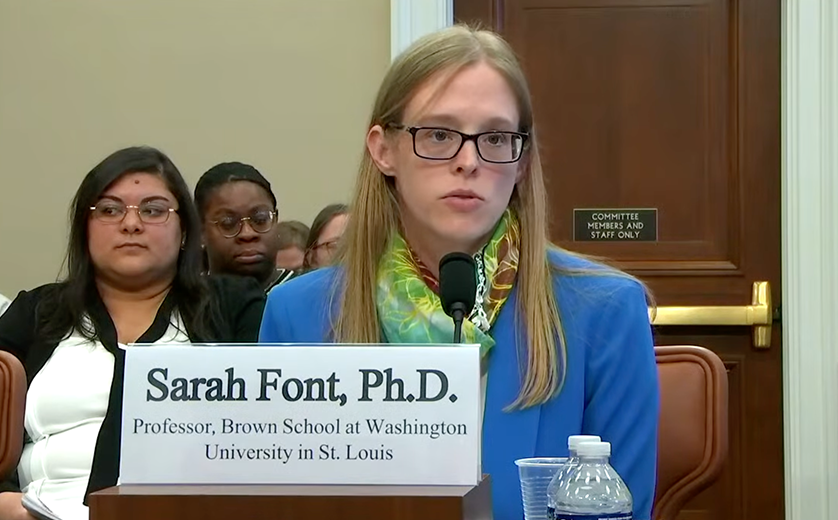
Sarah Font, professor at the Brown School at Washington University in St. Louis and an expert on the child welfare system, testified March 26 before the U.S. House Appropriations Subcommittee on Labor, Health and Human Services, Education, and Related Agencies on the topic of federal funding for adoption programs.
The hearing, titled “Advancing Permanency in Child Welfare: Leveraging Federal Funding for Adoption Programs,” focused on improving adoption outcomes for children in foster care.
Font told the subcommittee that states routinely fail to facilitate timely, safe and stable adoptions. She cited federal data showing children spend a median of 31 months in foster care before adoption, with some states averaging more than 45 months.
According to the Adoption and Foster Care Analysis and Reporting System (AFCARS), about 329,000 children are in the U.S. foster care system.
Font highlighted a study comparing states’ permanency outcomes, noting that three years after entering foster care, only 57% of infants who were not reunified had been adopted. Adoption rates varied widely by state: more than 85% of infants in Iowa and Arizona were adopted within three years, compared with just 28% in New York. Older children faced even lower odds. Among children who entered care at ages 7-10 and were not reunified, fewer than one in four were adopted within three years.
“Nearly three decades have passed since Congress passed the Adoption and Safe Families Act (ASFA) to prevent children from languishing in foster care indefinitely,” Font said. “Today, the key provisions of ASFA continue to be poorly implemented and unenforced in many jurisdictions. Consequently, too many children spend too many of their formative years in temporary settings.”
Font said federal policy has focused heavily on achieving adoptions, with less attention on the quality of care children receive in those placements. She emphasized three areas to improve post-adoption outcomes: recruitment and screening of adoptive families, matching children with families, and preparation and post-adoption support
“Improving the rate, timeliness, and quality of adoptions from foster care starts with recruitment, both of foster families open to adoption and families specifically pursuing adoption,” she said. “But it is not a numbers game. Many of the youth who ultimately age out of care experience unsuccessful pre-adoptive placements or dissolved adoptions. Signing up more families will not change that.”
Instead, Font said the focus should be on supporting and retaining high-performing foster families, targeting recruitment to families whose skills align with children’s needs, and providing follow-up support to ensure a “forever family” is more than a slogan.
She recommended modernizing the process for matching children with adoptive families. She also urged experimenting with strategies to ensure adoption continuity, improving federal data collection, discouraging inappropriate reunifications, and preventing misuse of kinship guardianship.
Font began her career as a caseworker before becoming a researcher and professor.
The full testimony is available here.