See more of our coverage in your search results.
Add Brown School News on Google (opens in a new tab)By Diane Toroian Keaggy April 21, 2026
When newcomers to St. Louis succeed, the entire region succeeds, says Blake Hamilton, president of the International Institute of St. Louis.
That’s why he agreed to join with Mitra Naseh, an assistant professor at the WashU Brown School and founding director of the school’s Forced Migration Initiative, in her quest to foster belonging among the region’s large Afghan population and to find ways to better connect refugees to the services they need to thrive.
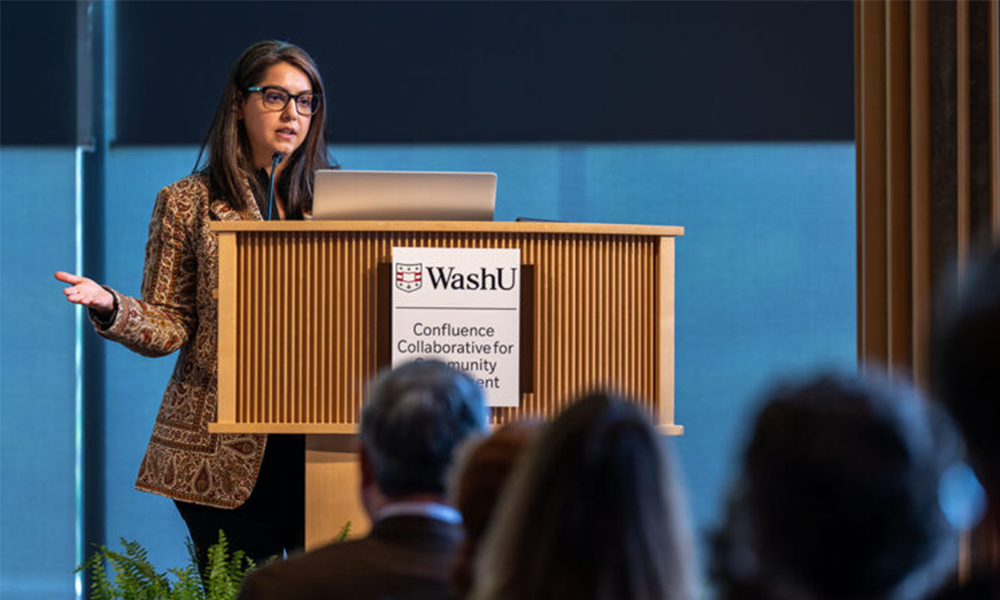
“This work also reminds us that welcoming is not a measure of individual effort alone. It is a measure of whether our region is prepared to unlock talent, recognize credentials, support families and create pathways to mobility,” Hamilton told attendees at the 2026 William H. Danforth St. Louis Confluence Award Research Showcase April 15 at the Clark-Fox Forum. “That’s why partnerships like these really matter so much. WashU researchers bring rigor, analysis and the ability to see patterns across systems. And community organizations bring trust, proximity and responsibility for what happens. Together, we move forward from insight to action.”
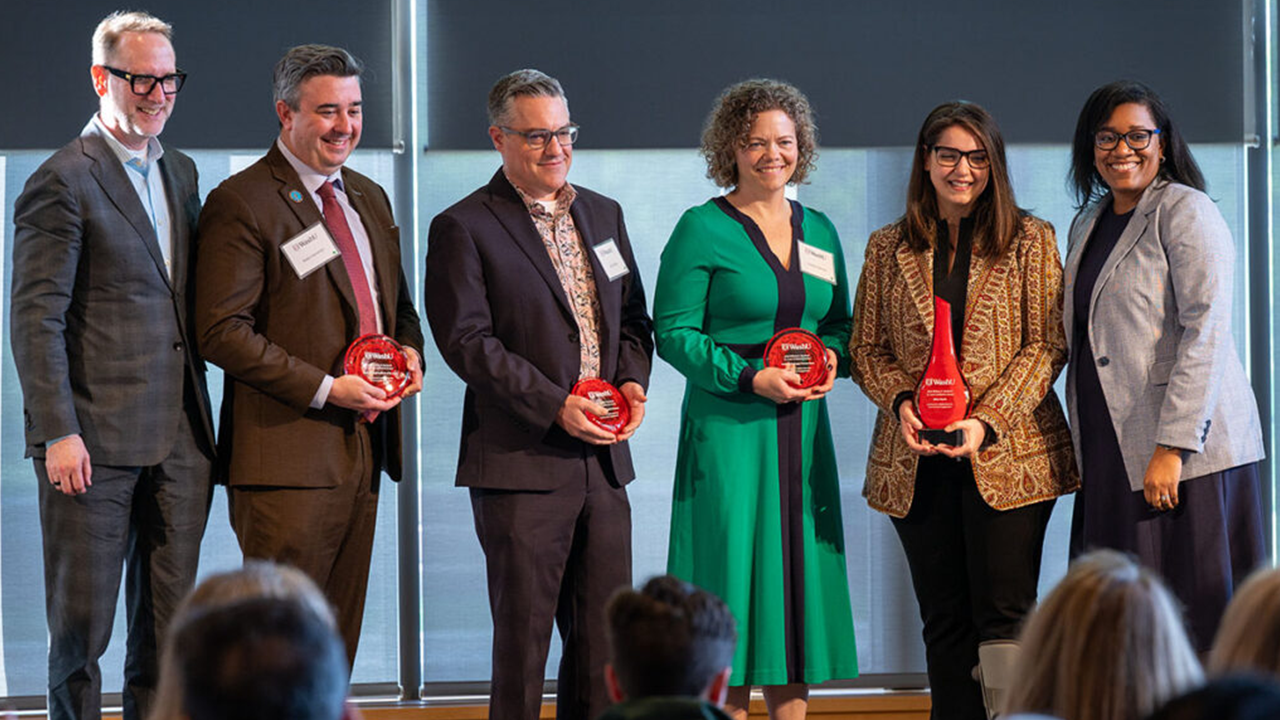
WashU’s Confluence Collaborative for Community Engagement honored Naseh and her community partners for her ongoing research with the Danforth St. Louis Confluence Award. Now in its fourth year, the prize recognizes researchers and community partners who work together to address regional challenges. In addition to Hamilton, Naseh’s community partners include:
Jason Baker, executive director, Monarch Immigrant Services in St. Louis; Haroon Safi, president, U.S. Afghan Chamber of Commerce in St. Louis; Fatema Medhat, Missouri state refugee health coordinator, U.S. Committee for Refugees and Immigrants; Aya Kawasaki, interim co-convener, Immigrant Service Providers Network; Lindsay Spencer, program manager, Archway Refugee Connections; Ann Wittman, director, Welcome Neighbor STL; Kara Gebre, program director, Refugee and Immigrant Services & Education; Lina Oleik, training and enrichment manager, Jewish Vocational Service of Kansas City.
Naseh’s research was born out of a simple question: “We just wanted to know how newly resettled Afghans are doing,” said Naseh, who arrived at WashU in 2022, shortly after a wave of about 600 Afghans resettled in St. Louis.
She found that Afghan families, though poor, were better off than the Afghan communities in Portland. Ore., because of the availability of jobs and low-cost housing. She also found that Afghans who remained deeply connected to others in their own community felt the highest levels of belonging and well-being. Currently, Naseh and her team are studying the barriers between the region’s immigrants and refugees and available services and resources.
“Our community partners are helping us with language access and the idea is that next year, we will start co-designing solutions for some of the identified barriers and ways to leverage facilitators that help fit the intervention,” Naseh said.
Baker of Monarch Immigrant Services calls his partnership with Naseh one of the most constructive of his career.
“I have to confess that as someone who has been around community-university partnerships, I was a little skeptical, maybe even a little cynical, as to the motivations of a junior faculty member, new in town, who wanted to talk about data,” Baker recalled. “I am so happy to have said yes.”
Spencer, of Archway Refugee Connections, said her organization already has incorporated some of Naseh’s findings in its programming, which includes English language classes for women and field trips for families. Naseh’s students also provide wrap-around services to Archway families with the highest need.
What we know is that if basic needs are not met, people are not able to come into class and feel ready to learn, to make those connections and to build community in St Louis,” Spencer said. “The collaborations that we have established here together is the reason why St Louis is a welcoming city to our immigrants and refugees.”
In addition to the Danforth Award, the Confluence Collaborative announced its 2026 Provost Impact Award for Early Career Community-Engaged Research winner:
REBIRTH: Revitalizing Birth in Rural Communities of Southeast Missouri (Faculty lead: Victoria Brown, postdoctoral research fellow, WashU Medicine. Community partners: Bootheel Perinatal Network, Building Blocks, Missouri Bootheel Regional Consortium, MPower–Mississippi County Health Department, ParentLink, It Takes a Village)
The collaborative also announced the Provost Impact Award winners. They are:
Nourishing Healthy Starts (Faculty lead: Dan Ferris, associate professor of practice, Brown School. Community lead: Kristen Wild, president and CEO, Operation Food Search)
Parents and Children Together–St. Louis: Community Voices Driving Change for Families (Faculty lead: Patricia Kohl, professor, Brown School. Community lead: Sanaria Sulaiman, president and CEO, Vision for Children at Risk)
Black Children’s Joy and Educational Justice: A Portraiture Study on Effectiveness of a School District’s Strategic Plan around Anti-Racism and Wellbeing (Faculty lead: Seanna Leath, associate professor of psychological and brain sciences, Arts & Sciences. Community lead: Sharonica L. Hardin-Bartley, superintendent, University City School District)
Wheelchair user physical activity training intervention to enhance cardiometabolic health (WATCH): A community-based randomized control trial (Faculty lead: Kerri Morgan, associate professor, WashU Medicine. Community lead: Annie Morrow, chief program officer, Paraquad)
Building Pathways: Cultivating Diverse Futures Through K-12 and University Design Education (Faculty lead: Kelley Van Dyck Murphy, associate professor, Sam Fox School. Community lead: Ronda Wallace, principal, Sumner High School)