Janeka Haden, MSW ’23, presents on racially restrictive covenant agreements during the Dec. 15 event.
Do a quick internet search about housing in St. Louis and the results are pretty clear. Blaring headlines that the St. Louis area is facing a housing crisis. The issue is particularly stark for Black households, low-income families, and renters.
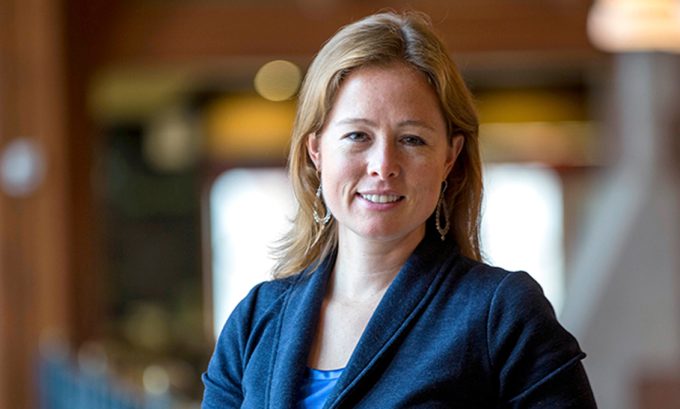
But this crisis isn’t by happenstance. In the United States and in the St. Louis region specifically, historical policies have led to segregated housing by design. To address the issue, Molly Metzger, a senior lecturer at the Brown School and faculty director for the Center for Social Development, worked with masters of social work students enrolled in her social-policy course to develop a policy briefing book titled, “Welcome Home: A Policy Briefing Book for Housing Opportunity in St. Louis County.” Written by the students and edited by Metzger, the briefing book aims to broaden opportunity by offering ideas for housing policy changes with a particular focus on majority-white, inner-ring suburbs of St. Louis, like Clayton, Kirkwood, Maplewood, Richmond Heights, Rock Hill, Shrewsbury, and Webster Groves.
“Whether we talk about the problem in terms of ‘affordable housing’ or ‘attainable housing’ or ‘workforce housing,’ the bottom line is the same: We do not have the housing to meet the need,” Metzger said. “This problem is particularly acute in the overwhelmingly white parts of our region that use single-family zoning and other practices to self-segregate.” Additionally, she said generational policy decisions in St. Louis County have left those communities less accessible, and less economically and racially diverse.
The briefing book highlights historical and current housing trends and offers four solutions for creating new housing opportunities in St. Louis County.
- Racially Restrictive Covenants: A Story of Segregation, Disinvestments, and Lingering Implications
- Zoning: Issues and Reform
- Advancing Racial Equity Through Community Land Trusts
- Linkage Fees: A Vehicle for Financing Affordable Housing
“These policy solutions are not radical. With our community partners, we tried to craft a policy agenda that would be feasible and would build some momentum in the process,” Metzger explained. She said sharing the history of racism in St. Louis is not to make people feel bad. “For those of us fostering these conversations, it’s not out of self-hatred. It’s not about hatred of any variety. This is about an honest acknowledgment of the harms done by specific policy decisions, in order to motivate action.”
Metzger teaches the social policy course in partnership with Mayor Laura Arnold of Webster Groves, Missouri, Webster Groves’ Alliance for Interracial Dignity, and Women’s Voices Raised for Social justice.
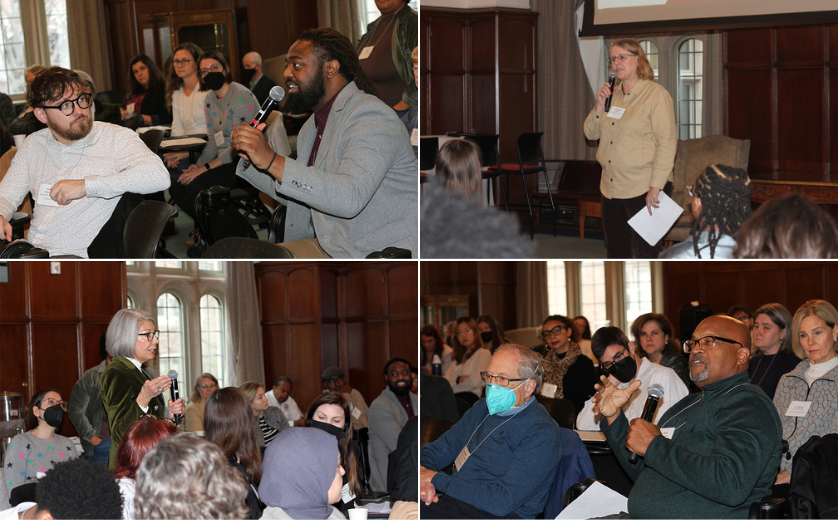
Metzger’s students presented their ideas to a group of community leaders, mayors and city council members at an event held at Washington University in December 2022. Also in the crowd were State Representatives Sarah Unsicker and Deb Lavender. In introductory remarks, Mayor Arnold of Webster Groves rallied the group, “It’s time to take some action!” Arnold noted that part of the problem is that too many residents think the housing crisis someone else’s problem or happening somewhere else, failing to recognize this is happening in our very own communities.
“If a teacher in your school district. If one of your public works employees or if the waiter at your hot new restaurant cannot find housing within your community that community is not complete,” she said. “The people who work in our communities deserve the opportunity to live there as well.”
Metzger said people aren’t powerless over this issue. They can make decisions that have a meaningful impact on communities. They can decide where they live, who they sell their home to, and how they show up as members of their community. While she has yet to see transformative policy change, she does see a growing awareness of the housing crisis and some encouraging first steps.
JaNiene Peoples (left) and Yingying Zeng are GCSW inaugural doctoral awardees.
Brown School doctoral student JaNiene Peoples and Yingying Zeng, a Brown School doctoral candidate, have been awarded Grand Challenges for Social Work (GCSW) Doctoral Fellowships.
Peoples and Zeng are among 13 social work students nationwide selected for this inaugural cohort of doctoral awardees. The fellowships are funded by a grant from the New York Community Trust and provide mentorship and a $3,000 stipend to support the recipients’ dissertation or capstone expenses. The program’s aim is to increase the number of social workers committed to addressing the 13 subject areas supported by the GCSW, which champions social progress through science.
Peoples’ research project falls under the “eliminate racism,” category. Her research project is titled “Mechanisms Linking Racial Discrimination and Substance Use in Black College Students: An Ecological Momentary Assessment Study.”
“Racial discrimination and substance use are pressing public health issues that disproportionately impact Black Americans,” she said. “Receiving the Grand Challenges for Social Work Doctoral Award enables me to center health equity, enhance health disparities research related to substance use, and inform prevention and intervention efforts for Black and other racial and ethnic minority students on college campuses.”
Peoples is honored to have been selected for the fellowship and welcomes the support for her dissertation study in combatting racism.
Zeng’s project “Immigrants’ Experiences of Asset Building: Implications for Asset-Based Policies” focuses on the “build financial capability & assets for all” category.
“Receiving the Grand Challenge for Social Work Doctoral Award enables me to translate my research from theoretical to practical,” Zeng said. “I hope that findings from my dissertation can inform immigrant integration policies and programs, target vulnerable immigrant families and provide support to facilitate asset accumulation and long-term stability.”
Honorable mentions were given to doctoral students Nancy Jacquelyn Pérez-Flores and Peter Sun for their proposals on mental health literacy and rural health disparities.
Ali Margherio was five years into a stint as a St. Louis area wedding planner when the COVID-19 pandemic started to roll across the globe. A return to higher education and a career change was always the plan. But the time never seemed right.
Her job impacted by the pandemic; Margherio enrolled in the Brown School’s Master of Social Work program in 2021. “I took stock of what I was doing and my joy level and realized it was time for a shift,” she said.
The bearer of a history degree, Margherio thought she would be a history teacher. Conversations with her teacher wife and social work friends made her realize that she didn’t want to teach, but instead wanted to help people who were struggling.
Fast forward and Margherio is a second-year master of social work student with a focus on mental health. A former Division 1 athlete, Margherio is interested in working in mental health with collegiate student athletes. She is currently completing a practicum with Washington University’s Department of Athletics. In fact, Margherio created the practicum with WashU Athletics after not finding any existing placement that met her criteria.
She pitched the idea to Ryan Lindsay, associate professor of practice and the chair of the mental health concentration, who she said was instrumental in facilitating the practicum and supporting her through the process.
While a lot of students don’t typically go the build-your-own-practicum-route, Lindsay wasn’t surprised Margherio took that option.
“Ali isn’t afraid to build something without knowing how it turns out,” he said. “When Ali approached me to explore how she could combine her lived experiences as a college athlete and her desire to promote mental wellness, I was more than happy to support her in this endeavor. Ali is truly a compassionate, driven, and thoughtful student who will take this learning opportunity forward to create even greater impact.”
Lindsay said students at the Brown School are encouraged to explore and find opportunities to fill gaps and establish practicum sites with new stakeholders.
Margherio jokingly reflected on the process of creating her practicum: “I went to the athletic department and said this is who I am, this is my background, this is what I’m passionate about – please let me work for you for 600 hours for free. And they were like, OK.”
A rower in college, being a student athlete was a huge part of Margherio’s identity. She understands the complexity of balancing school, sports and a social life.
“It’s becoming more and more apparent that athletes in general, and specifically college student athletes are struggling to figure out the balance. When you get to the point where you’re a collegiate student athlete, you’ve been an athlete for most of your life and at a very high level. It’s a little bit of an identity struggle of ‘I’m a student and I’m an athlete, but where does me as a human fit into that?’ I think that causes a lot of anxiety.”
Additionally, she notes that a low percentage of collegiate athlete students go on to play professionally. Meaning, their journey and identity as a competitive athlete typically concludes at the end of college, potentially causing stress, anxiety and depression.
She feels it’s vital to support student athletes during these critical transitional points – entering college and leaving college.
“These are important shifts that weren’t talked about very much when I was a collegiate student athlete,” Margherio noted.
“We kind of accidentally started a business”
Margherio’s pivot to social work wasn’t the only career-related change that happened during the pandemic. Margherio and her wife founded a small Spanish-immersion learning collaborative called Casco Learning. Located in Chesterfield, Missouri, it serves to support homeschooling families. What started as a pandemic pod school for nine students has grown to 35 enrolled students and a waitlist.
“We kind of accidentally started a business,” she joked. She describes her role in Casco Learning as doing “all the business-y things.”
Margherio continues to wear her dual business and social work hats at the Brown School.
“One of the things that I really liked about the Brown School was that I could take classes in other schools,” she said. She enrolled in a business course with Doug Villhard, Professor of Practice in Entrepreneurship and Economic Director for Entrepreneurship at WashU’s Olin Business School.
Last year, Villhard encouraged Margherio to enter Casco Learning in the Skandalaris Venture Competition (SVC), which provides mentorship to new WashU ventures and startups to ready them for commercializing their idea, launching, and pitching to investors.
Margherio made it to the semifinals. While not a winner, she said it was a great learning opportunity. Ultimately, she would love to be a clinician, working directly in a mental health setting with collegiate student athletes. Her goal is to normalize mental health discussions among student athletes.
In Ghana, it’s common for high school students to attend single-gender boarding schools — an element of an education system introduced by colonial missionaries.
Now, almost 150 years after the founding of the first missionary school, many of these institutions have become harbingers of bullying culture. In Ghana, the harmful practice is popularly referred to as “homoing.” Committed by seniors and older students to control juniors and younger and vulnerable student populations, the methods include domination, verbal attacks, shaming, forced kneeling, and demoralizing tasks.
This damaging tradition is the focus of a chapter co-authored by Brown School Master of Public Health student, Baffour Boaten Boahen-Boaten. The chapter, “Bullying in the Name of Care: A Social History of Homoing Among Students in Ghanaian Boarding Schools,” is a socio-historical analysis of homoing among the student population; the origin and meaning of the name; its roots in colonialism; and how the behavior facilitates certain forms of social exclusion and social inclusion among students.
The chapter is part of the book “Global Perspectives on Boarding Schools in the Nineteenth and Twentieth Centuries,” which brings together a collection of scholarly works from around the world examining the social complexities of ‘boarding schools’ as a global and transcultural phenomenon.
Boahen-Boaten said homoing is causing substantial social and public health burdens in boarding schools – sullying spaces that are designed to provide care.
“In these places where students are supposed to receive care, it’s important not to create subcultures that become harmful,” Boahen-Boaten said. “When people congregate in a place with its own subculture, it’s ripe for homoing behavior.”
Boahen-Boaten, a former boarding school pupil and native of Ghana, collaborated on the chapter with De-Valera N Y M Botchway, a history professor and head of the History Department at the University of Cape Coast, Ghana.
After receiving his bachelor’s in psychology degree from the University of Cape Coast, Boahen-Boaten earned a master’s degree in Global Mental Health from the University of Glasgow, Scotland, UK. He holds a Postgraduate Diploma in HIV/AIDS Management from the University of Stellenbosch, South Africa. Prior to attending the Brown School, he was a lecturer in psychology at Eswatini Medical Christian University in Eswatini (formerly Swaziland) in southern Africa. He has been vocal on the concept of decolonization of knowledge and designed an ‘African Psychology’ course as a lecturer.
He also co-authored the chapter “Suicide in Low-and Middle-Income Countries” in The Palgrave Handbook of Sociocultural Perspectives on Global Mental Health.
His interests range from psychosocial aspects of HIV/AIDS, global mental health, and building Black/African-centered interventions. Boahen-Boaten is the chair of the Global Health Student Advisory Committee (GHSAC).