See more of our coverage in your search results.
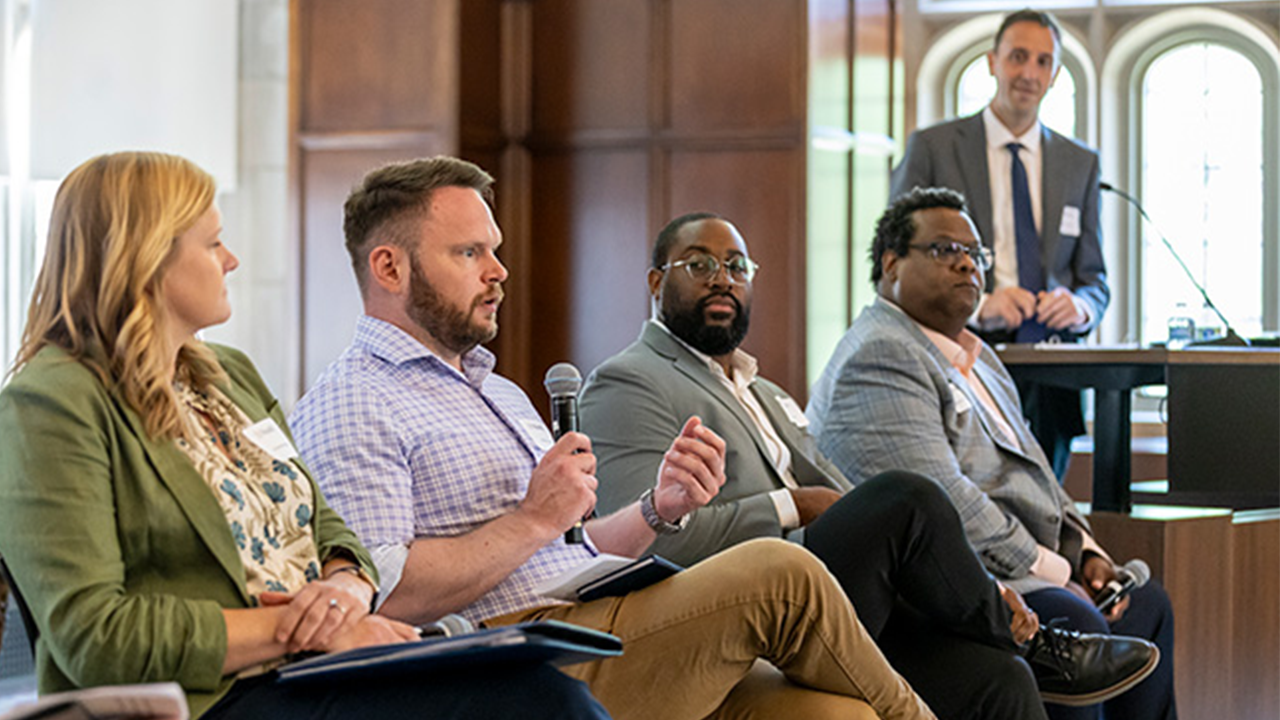
On June 30, the Clark-Fox Policy Institute hosted “Federal Cuts, Local Consequences: How St. Louis Can Respond to an Unraveling Safety Net,” as part of its Senior Policy Fellows initiative, in collaboration with the Center for Social Development. The event brought together researchers, practitioners, nonprofit leaders, advocates, policymakers, and students to discuss the impact of the One Big Beautiful Bill Act (OBBBA) on social safety net programs and how communities like St. Louis can respond to the changes.
The panel was moderated by Clark-Fox Policy Institute Inaugural Faculty Director Jason Jabbari and included:
- Stephen Roll, Senior Policy Fellow, Assistant Professor, and Director of Research at the Brown School’s Center for Social Development;
- Christine Woody, Food Security Policy Manager at Empower Missouri;
- Adam Pearson, Director of the Department of Human Services for the City of St. Louis;
- Marius Johnson-Malone, Co-Founder and Chief Strategy Officer of Civic Insight; and
- Kristen Wild, President and CEO of Operation Food Search.
Jabbari opened the event by framing the discussion around the local implications of federal policy changes, encouraging panelists and audience members to consider how families, service providers, and communities can respond as access to safety net programs evolves.
The program began with brief presentations from each panelist. Roll shared how changes to SNAP and Medicaid under the OBBBA will affect families across Missouri. He explained that many St. Louis families rely on SNAP to have food on the table. Under the new law, SNAP participants will face more frequent eligibility recertification and work reporting requirements, increasing administrative burdens that could make it more difficult for eligible families to maintain benefits. Similar reporting and recertification requirements will also apply to many Medicaid enrollees.
The discussion then shifted to strategies local communities could pursue to help reduce these burdens, including simplifying enrollment processes, improving cross-agency coordination, and offering additional stability support such as guaranteed income for families. While panelists discussed a range of local strategies, they also acknowledged the limits of what local governments and nonprofits can do when federal support is reduced. As Wild noted, “The charitable food system cannot replace what the federal safety net program does.” Pearson echoed that message, explaining that local governments simply do not have the resources to fill the gaps left by reductions in federal support.
Throughout the discussion, panelists emphasized that responding to these challenges will require collaboration across sectors. They highlighted the importance of advocacy at the local, state, and federal legislative levels; streamlining enrollment and recertification processes through stronger interagency partnerships; and continued investment in flexible supports that help families navigate periods of instability. As Woody pointed out, “… there is not one way to effect change in our community, that it takes all kinds.”
Although many of the OBBBA’s provisions will not take full effect until 2027, panelists stressed that families are already beginning to experience uncertainty and disruption. The discussion concluded with a shared call to action: collaboration across research, nonprofits, healthcare, philanthropy, and government will be essential to strengthen policies, improve access to services, and support children, families, and communities as these changes unfold.