See more of our coverage in your search results.
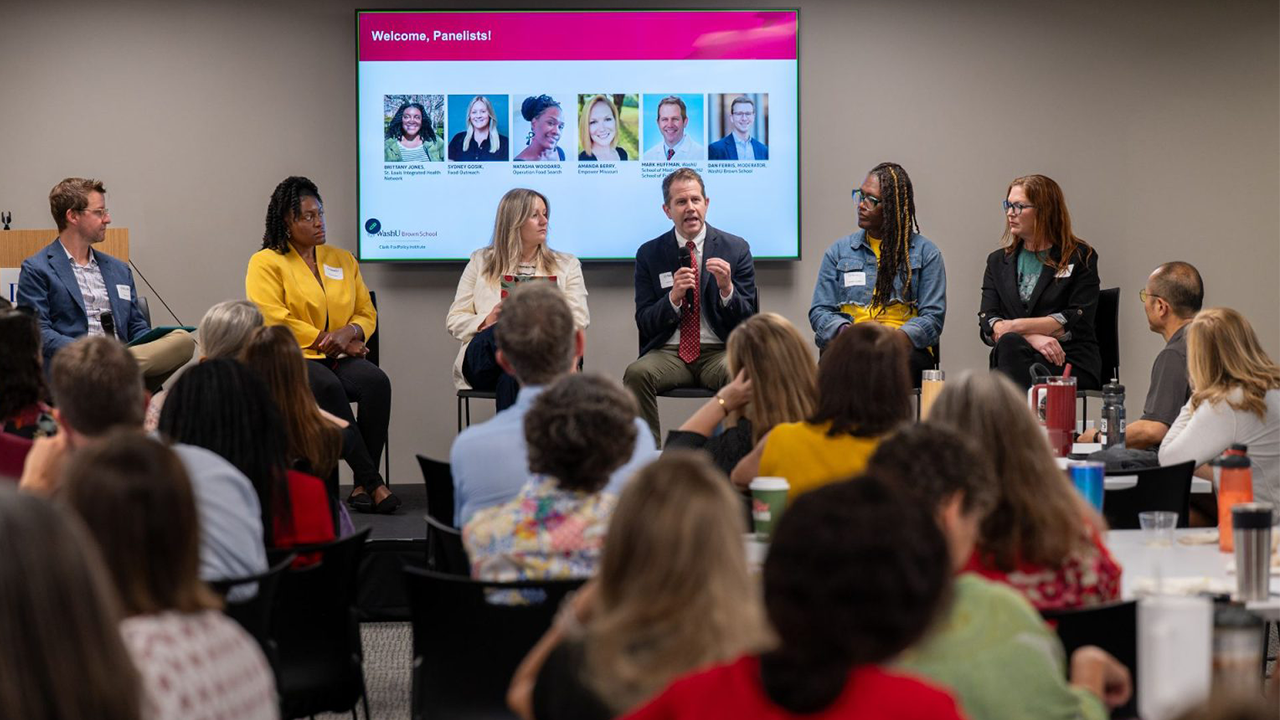
On June 16, the Clark-Fox Policy Institute joined with a coalition of WashU partners to host “Food is Medicine: Policy and Program Innovation in St. Louis.” The panel explored the growing Food is Medicine movement and opportunities to improve the lives of St. Louisans impacted by food insecurity, health disparities, and intersecting social challenges.
Hosted at the Delmar DivINe as part of the Clark-Fox Policy Institute’s Senior Policy Fellows initiative, the event reflected the Institute’s commitment to connecting research, lived experience, and policy to advance evidence-informed solutions that improve the lives of children and families in St. Louis and beyond. The event brought together more than 100 researchers, nonprofit leaders, and community members, highlighting the region’s growing interest in Food is Medicine and opportunities for stronger cross-sector collaboration.
The morning began with a networking reception designed to foster new connections across sectors before the discussion. Following opening remarks from Clark-Fox Policy Institute Director Jason Jabbari, Brown School faculty member and CFPI Senior Policy Fellow Dan Ferris moderated a discussion featuring Brittany Jones, MSW/MPH ’24, of the St. Louis Integrated Health Network, Sydney Gosik, MSW/MPH ’20, of Food Outreach, Natasha Woodard of Operation Food Search, Amanda Berry of Empower Missouri, and Mark Huffman, William Bowen Professor of Medicine at Washington University School of Medicine.
Panelists discussed the rapid growth of Food is Medicine initiatives nationwide, fueled by increasing investment from healthcare systems, federal agencies, and philanthropic organizations. While acknowledging that Food is Medicine encompasses a wide range of approaches, speakers emphasized a shared goal: addressing nutrition and food insecurity as essential components of improving health and preventing chronic disease.
“Food is Medicine is not a single intervention, but a comprehensive strategy,” said Natasha Woodard of Operation Food Search. Woodward continued to explain that this strategy is one that can address “food security before it leads to more significant health challenges.”
As the discussion continued, panelists emphasized that the question is no longer whether Food is Medicine works, but how to responsibly scale successful models to reach more people. Speakers agreed that no single organization can accomplish this work alone. Instead, expanding Food is Medicine will require stronger partnerships among healthcare systems, researchers, policymakers, and trusted community organizations.
Throughout the conversation, panelists also stressed that many of the practices now receiving national attention have been led by community organizations for decades. Local growers, food providers, residents, and community leaders bring essential expertise that should shape the future of Food is Medicine. As healthcare investment in these initiatives continues to grow, speakers emphasized that healthcare systems should build partnerships with the trusted community organizations already leading this work, rather than replacing them.
During the audience question-and-answer session, participants reflected on both the opportunities and challenges of advancing Food is Medicine efforts in the current economic and political climate. Responding to a question about how community members can become involved, Amanda Berry, Food Security Policy Manager at Empower Missouri, emphasized the importance of sustained commitment. “The work does not stop. It takes a sustained effort—long-term—and we’re going to get it done. You’re welcome to join us in this. We will get it done.”
That spirit of collaboration carried beyond the panel discussion. Conversations that began during the event’s networking reception have already led several attendees to express interest in working together on future Food is Medicine initiatives, reflecting the event’s success in building new connections across organizations committed to improving health and food security throughout the St. Louis region.
This event was co-sponsored by the Clark-Fox Policy Institute, Center for Social Development, Confluence Collaborative, Public Exchange, Center for Diabetes Translation Research, Institute of Clinical and Translational Sciences, and the WashU Bursky School of Public Health’s Food and Agriculture Research Mission (FARM).