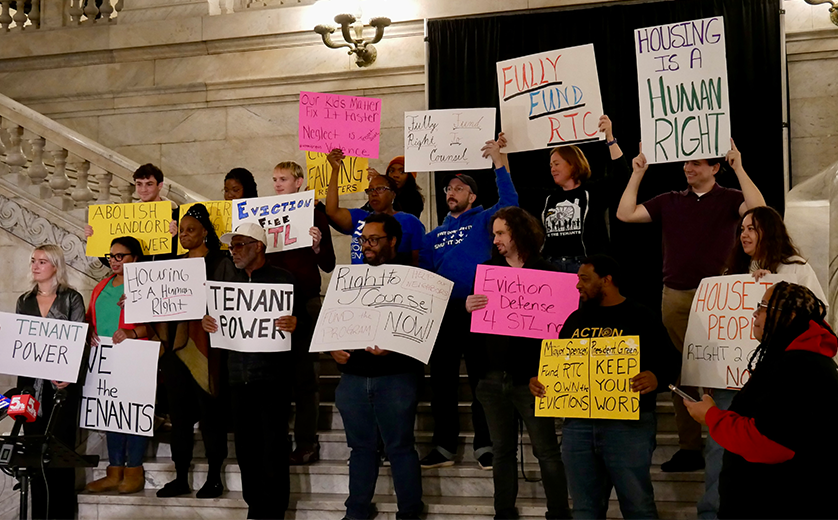
When a tornado tore through the St. Louis region last May, Chloe Brewer, a Master of Social Work student at Washington University’s Brown School, lost her apartment. Though her home was uninhabitable, her property management initially insisted she continue paying rent.
Brewer recently recounted that experience during a meeting of the Housing, Urban Development and Zoning Committee of the St. Louis Board of Alderman, advocating for full funding of the city’s Housing Eviction Law Program, also known as the Right to Counsel Program. The program provides access to legal representation for tenants facing eviction.
“They would have made me pay rent for the month of June, only two weeks after the tornado, despite having no place to live,” Brewer told the committee. “The only reason that didn’t happen to me is because I had a personal connection to an attorney who was willing to advocate for me, without payment.”
She urged city officials to fund the program at the $2.5 million level promised in 2023.
Brewer was one of four Brown School MSW students who applied classroom lessons to real-world policy debates as part of the Domestic Social and Economic Development Policy course. Students testified on city budgets, housing justice, and county planning, addressing issues ranging from tornado recovery and eviction prevention to sustainable development. Their work stemmed from an assignment requiring students to participate in or simulate public testimony.
Michael Higgins, another MSW student, shared his own housing struggles before the Housing, Urban Development and Zoning Committee while calling for increased funding for the Right to Counsel program.
“For the first two months of my lease this fall, I sat with my hands tied as my shower water poured down into my neighbors below me,” Higgins said. “At the same time, the neighbor down the hall from me had sewage leaking from his roof. And we could not do anything because we could not afford to go to court with our landlord.”
Molly Metzger, a teaching professor and chair of the Domestic Social and Economic Development concentration, said the experience of writing and delivering testimony gives students insight into how policy works while sharpening their advocacy skills.
“It’s not about being perfect; it’s about showing up and engaging in the democratic process,” Metzger said. “This hands-on experience equips students with the skills to navigate and influence policy at the local, state and federal levels.”
Students prepared collaboratively with Metzger but had full autonomy over their testimony topics and political positions, submitting papers outlining their strategies.
Callum Stefanelli testified before the St. Louis Board of Aldermen’s Budget and Public Employees Committee in support of a resolution calling for the Employees Retirement System to divest from companies complicit in genocide. Stefanelli also spoke in support of three bills appropriating additional funds for tornado relief and winter rehousing efforts.
“As an aspiring social worker, I have a moral obligation, standing in front of you all today, to champion the idea that housing is a human right,” Stefanelli said.
The Board of Alderman approved the divestment resolution and the three bills providing more than $13 million to expand the city’s efforts to house and shelter residents this winter. Mayor Cara Spencer later signed the bills into law.
Hannah Jumper, who grew up in Jefferson County, opposed a new subdivision before the Jefferson County Planning and Zoning Commission. She urged officials to consider school capacity, emergency services, and infrastructure before approving development
“I am being trained as a social worker, and I am taught to look at people in the context of their environment to empower them to be their best self,” Jumper said. “Lately, I have been learning how communities can be looked at in a similar way. When I think about Jefferson County in this way, I see a place that I loved to grow up in, but I also see a place bursting at the seams.”
Metzger said the course demonstrates that local engagement can produce tangible results and that democratic participation is a skill that can be learned.