Gena Gunn McClendon, director of community engagement at the Brown School’s Center for Social Development (CSD) at Washington University in St. Louis, died Saturday, Oct. 21, 2023, in St. Louis after a battle with cancer. She was 65.
McClendon also served as director of CSD’s voter access and engagement initiative and co-director of the financial capability and asset building initiative. Her work primarily involved policy research analysis and consultation with community-based programs, academic institutions, state and federal policymakers, and advocacy groups.
McClendon began working at the university in 2001 as a project associate at the Center for Social Development.
“Across more than two decades at the university, Gena was a highly productive director of community engagement at the CSD,” said Michael Sherraden, the George Warren Brown Distinguished University Professor and CSD’s director.
“Throughout her career, Gena was interested in evidence and positive action toward racial equity, democracy and full participation in society. Her work has resulted in substantive and continuing changes, including asset-building policies in U.S. states, and regional asset-building coalitions in the South,” he said.
“Gena was welcoming and cordial to everyone,” Sherraden said. “She was highly valued as a colleague at the university and in the community. Dr. McClendon was a woman of understanding, kindness, steady vision, positive action and grace. She will be greatly missed.”
A celebration of life will be held at 10 a.m. Nov 4 at Christ Pilgrim Rest MB Church, 1341 N. Kingshighway Blvd., St. Louis, Mo., 63113.
Washington University in St. Louis is partnering with the St. Louis Integrated Health Network (IHN) on a five-year $3.8 million grant from the Centers for Disease Control and Prevention (CDC).
The grant is part of the CDC’s Racial and Ethnic Approaches to Community Health (REACH) program. The funding aims to help improve health, prevent chronic diseases and reduce health disparities in the local Black community residing in the St. Louis Promise Zone.
The St. Louis Promise Zone is an area that includes parts of north St. Louis city and north St. Louis County, designated in 2015 as part of a federal program intended to increase economic activity, improve educational outcomes, reduce serious and violent crime, invest in transformative development and improve health and wellness in high-poverty urban, rural and tribal communities.

Andwele Jolly, president and CEO of IHN; Denise Wilfley, the Scott Rudolph University Professor of Psychiatry, of medicine and of pediatrics at the School of Medicine, and of psychological and brain sciences in Arts & Sciences; and Diana Parra Perez, an assistant professor at the Brown School, will lead the REACH-STL project, which will implement proven public health strategies. It is among 41 REACH recipients.
“The St. Louis Integrated Health Network is committed to advancing health equity, improving health care delivery and eliminating disparities in the St. Louis region,” Jolly said. “This grant provides us the opportunity to address the interconnectedness of medical, social and environmental contexts that influence health outcomes.”
The REACH-STL project will use three main strategies:
- Healthy food choices easier everywhere: promoting food service and nutrition guidelines and expanding fruit and vegetable voucher incentives and produce prescription programs. REACH-STL will work with the Building Resilient Inclusive Communities (BRIC) program led by Parra Perez and with Nutrible, a web app that will help deliver medically tailored meals to individuals at home, and digitize and incorporate BRIC’s 24 community organizations into Nutrible’s robust collection of healthy food options, diverse dietitians and community resources.
- Safe and accessible physical activity: connecting pedestrian, bicycle or transit transportation networks to everyday destinations through collaboration with community partner Trailnet.
- Family healthy weight programs: improving access to effective, family-centered, culturally relevant health behavior and lifestyle treatment programs.
“Through REACH over the next five years, we will continue to leverage the work that BRIC started in 2021 and expand our partnership to include much-needed clinical-community approaches,” Parra Perez said. “We will continue to address health equity in a consistent manner across all strategy areas by assuring that the solutions and interventions are community-driven, placing a high value on food sovereignty, dignity, agency and food justice.”
“In REACH-STL, we recognize that health is at least as much a structural issue as it is an individual one,” Wilfley said. “Through robust academic-community partnership across disciplines, we seek to improve community health at multiple levels simultaneously.
“We will expand access to our CDC-recommended family-based behavioral treatment for promoting overall health and healthy lifestyles across the lifespan by helping families develop skills for navigating an unequal food and built environment, while also facilitating access to healthful foods and improving St. Louis’ infrastructure for safe spaces for physical activity. I couldn’t be more thrilled to work with this outstanding team of community collaborators.”
Robert Sagastume’s life journey began in Honduras and proceeded to the U.S. and the Brown School, where his talents and training led to work and the opportunity to realize an early dream: Being elected to a big-city School Board.
An undocumented immigrant who came with his mother to the U.S. from Honduras at the age of 12, Sagastume, MSW/MSP ’19, eventually became a naturalized citizen and moved from his home in Kansas City to St. Louis, where he specialized in nonprofit management and policy at the Brown School. “I have always been super interested in how systems work and the impact they have in communities,” he said. “The Brown School allowed me to refine some of the skills I had and gave me the platform to hone my expertise in education and policy.”
Sagastume was a practicum student at the school’s Clark-Fox Policy Institute (CFPI) and 2018 CFPI Graduate Policy Scholar. CFPI Director Gary Parker said Sagastume’s journey reflects the potential of utilizing acquired knowledge and skills to enact real change.
“Witnessing Robert’s growth and commitment to equity and education while a practicum student at the institute was truly a privilege. His dedication serves as a reminder of the difference one individual can make,” Parker said.
Sagastume worked for the Scholarship Foundation of St. Louis as a student advisor before returning to Kansas City in a similar role. Now, he is a senior family college prep program advisor with the Hispanic Development Fund of the Greater Kansas City Community Foundation. He provides family and academic advising support centered on students who’ve completed their high school studies and are seeking opportunities in postsecondary education and alternative pathways.
He had always hoped to join the School Board and put his policy training into practice, and last summer he saw his chance. A member of the Kansas City School Board resigned, and Sagastume became one of two write-in candidates for the position with less than three weeks to go before the election. “I canvassed every day listening to community members and helped them understand why I was running,” he said. “My district has the highest percentage of immigrants, and we did need to talk about equity and inclusion on the Board.” His campaign was a success and Sagastume, sworn in in June, is now voicing community concerns as an elected member of the Board.
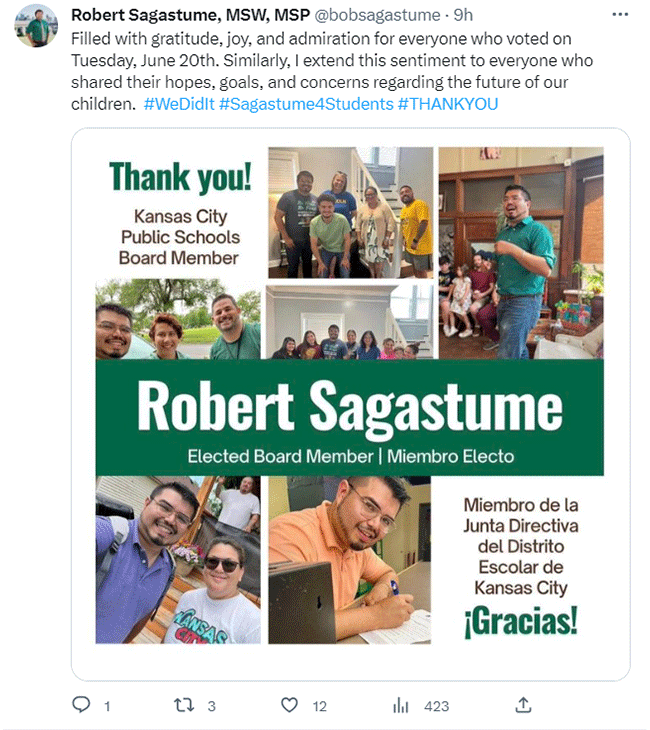
“I want to make sure our communities are included in conversations about education,” he said. “Understanding and overcoming my own barriers and limited resources motivated me to help others do the same. When I decided to go to college I was undocumented, and one of the things that I’ve learned is that there are systems in place and we can create changes if we prepare ourselves. I’m Latino, but I want to represent all immigrants in my district, not just Latinos.”
“The school board is at the core of what I’m fighting for; access to education, but also equitable policies, to create more impact,” he said. The possibilities are apparent in his own family. As the only one of eight children to go to college, he became something of a model for younger family members – his nephews and nieces are now in college. “It’s really nice to be able to inspire others and give them the resources and tools that they need,” he said.
Working with students motivated him to run for the School Board to address challenges immigrants are constantly facing: language gaps, a lack of understanding of available resources, and making sure there’s someone around who looks and sounds like them, he said.
“It’s truly given me a lens of understanding the why of some challenges, and I’m seeing how the why impacts the community,” he said.
Wherever his career leads, Sagastume says, he’ll remember those who helped him early on
“I am here doing what I’m doing because I’ve always had a group of people who have believed in my dreams,” he said. With their support, and the support of schools like the Brown School I was able to push myself into places I wouldn’t have gone otherwise.”
While a graduate student at Washington University in St. Louis, Rachel Marsh, JD ’00, MSW ’00, first saw how social workers and lawyers together navigate some of the most tragic scenarios faced by children and families. For a Brown School practicum, Marsh worked at the Children’s Advocacy Center in St. Louis, serving children who had been victimized by sexual abuse.
“As therapists, we had to interact with attorneys because of the nature of the work we were doing. I still remember those children that we helped early on and our work with the courts,” Marsh says.
Two decades later, Marsh spends her days meeting with lawmakers, crafting and analyzing policy proposals, and researching best approaches for supporting youth with complex needs, among many other duties. She serves as chief executive officer of the Children’s Alliance of Kansas, an organization that advocates for family well-being and provides education and networking opportunities to its nearly 20 member organizations.
By design, Marsh’s path from St. Louis to the halls of the Kansas State Capitol in Topeka included several stops along the way.
“I always thought that it was important to work in the field before moving into the policy advocacy realm,” she says. “I wanted to deliberately work in different roles so that I could see the system from different perspectives over the years.”
Marsh started out serving children and families directly, first as an adoption case manager and later as a family law attorney. Her next position, as a lawyer for the child welfare provider Saint Francis Ministries, brought together the legal and social-services sides of her WashU training.
A few years into that role, Marsh paused to consider the sheer volume of court reports she had seen — around 10,000, she estimated. “I realized that I knew the issues case-by-case enough to talk about the trends and the policy implications,” she says. “And I began to gradually move toward that public policy lens.”
She became the vice president of advocacy at Saint Francis, accepted advisory roles on statewide panels and joined the board of the Children’s Alliance of Kansas. When the CEO position opened in 2020, she was ready.
In her current and previous roles, Marsh’s efforts have led to policy wins for kids. In 2019, Kansas became one of first states to adopt the Family First Prevention Services Act, a measure that has led to more than 1,000 fewer children entering foster care. Like many states, Kansas had previously experienced a rapid — and in Marsh’s view, avoidable — uptick in foster care cases.
“Many of the children who were entering foster care could have been safely maintained in their homes with the right services,” Marsh says. “We’ve learned over the years that there are some significant downsides to thinking that we can ‘save’ a child by placing them in a new family, potentially in a new community and school, and not able to contact relatives.
“If we can provide safety and well-being for a child in their home setting, then we want to prioritize that.”
In a separate effort, Marsh successfully garnered additional funding for the child welfare workforce of Kansas. Recruitment and retention of social workers — always a challenge, given the profession’s workload and emotional challenges — became even more difficult during the pandemic. The new funding allowed the continuation of quality care. Most recently, Marsh’s team focused on funding programs for older children with behavioral health problems, a group that makes up an increasing number of foster care placements.
Addressing these complex cases, like so much of Marsh’s advocacy, requires a wide range of expertise. The work is informed by the Children’s Alliance of Kansas’ wide network of dedicated professionals as well as Marsh’s own experience, starting at WashU.
“I can’t speak highly enough of the joint degree experience from Washington University, with the opportunities that it provided me to be creative in both fields and to meld them together,” Marsh says. “It’s a privilege to use my background in child welfare — informed by my law and social work degrees — to work in public policy for children and families.”
Leopoldo Cabassa, a professor at the Brown School at Washington University in St. Louis, has been appointed as a member of the Mental Health First Aid (MHFA) Research Advisory Board.
First introduced in 2021, the independent advisory group was convened to advance the research, monitoring and evaluation of MHFA courses in the United States. It is part of the National Council for Mental Wellbeing.
Cabassa is director of the PhD program at the Brown School and an expert on mental health services. His research centers on examining physical and mental health inequities in historically marginalized racial and ethnic populations with serious mental illness.
After Medicaid expansion began in Missouri in July 2021, the proportion of emergency department visits financed by Medicaid rose by nearly 15 percentage points, while the proportion of such visits financed by the uninsured dropped by 14 percentage points, finds a new analysis from the Center for Advancing Health Services, Policy and Economics Research at Washington University in St. Louis.
Similar trends were observed for inpatient hospital stays.
“These findings suggest that the expansion and growth in Medicaid enrollment in Missouri led to very large reductions in both the burden of uncompensated care for hospitals but also, importantly, out-of-pocket costs for previously uninsured persons in Missouri,” said Timothy McBride, the Bernard Becker Professor in WashU’s Brown School and co-director of the Center for Advancing Health Services, Policy and Economics Research at the university’s Institute for Public Health.
The analysis is based on changes in hospital visits over time in all hospitals in Missouri, before and after the start of the COVID-19 pandemic and Medicaid expansion, concentrating on emergency department visits and inpatient stays and the “payer mix” of those visits, which is the source of payment the hospitals receive (for example, private, Medicaid, Medicare and uncompensated).
While the findings of a significant reduction in patients with hospital visits that are uninsured is consistent with findings in other states that have expanded Medicaid, Missouri is relatively unique to have expanded Medicaid during the pandemic, McBride said.
“Disentangling the part of the changes we are observing that are related to the rise in enrollment on Medicaid during the public health emergency from the expansion is a challenge and will be a focus of future work,” he said. “We also intend to look in detail at the implications for people with chronic conditions in Missouri as compared to other states.”
The study also found significant geographic variations in how the expansion of Medicaid and the pandemic impacted regions of Missouri. Before the pandemic started, a higher proportion of emergency department visits and inpatient stays were funded by Medicaid in rural areas in Missouri, but the gap between urban and rural areas narrowed almost completely for emergency department encounters during the public health emergency.