People with serious mental illnesses, such as schizophrenia or bipolar disorder, die 10-25 years earlier than people in the general population, largely due to preventable medical conditions like cardiovascular disease, cancer, and diabetes. A new book by the Brown School’s Leopoldo J. Cabassa examines the reasons for these inequities and suggests ways to reduce or eliminate them. “Addressing Health Inequities in People with Serious Mental Illness: A Call to Action,” published by Oxford University Press, is the first book by Cabassa, a professor and co-director of the Center for Mental Health Services Research who focuses on mental health. The book has been more than a decade in the making.
“This book is deeply personal for me,” said Cabassa, who is Puerto Rican and has seen first-hand the impact of mental illness in his family, as well as the “double burden” faced by racial and ethnic minorities with serious mental illness. For more than 10 years, Cabassa has been researching the impact of mental illness and listening to the people who are affected. “I wanted to write a book for the general public that brings science, data, and people’s stories together to examine why these inequities are happening and what we can do about it,” he said. “These are the stories of people coping with these health issues and of the clinicians, researchers and policy makers working on the front lines to reduce these health inequities.”
Cabassa said that often, when people are diagnosed with serious mental illness, caregivers focus on mental health without attending to related physical illnesses and risky behavior, like smoking, and a lack of physical activity. Some unhealthy outcomes are caused by the untreated side effects of drugs patients are prescribed for mental illness. “Without appropriate supports and services, we’re putting people in a bind,” Cabassa said.
In the preface to the book, Cabassa writes that empathy has been central to his work. “It entails stepping into the world of others to understand their experiences without losing one’s perspective and objectivity…. to capture the lives of the people we are studying, to provide a voice to the voiceless, and to represent through numbers, stories, and analyses their needs, challenges, strengths, hopes, and dreams.”
Cabassa is also the Director of the Social Work PhD Program and of an NIH-funded training program in mental health services research and implementation science at Brown School. His work has been supported by the National Institute of Mental Health, the National Institute on Minority Health and Health Disparities, the Robert Wood Johnson Foundation, and the New York State Office of Mental Health.
Featured book in the WashU Bookshelf, which highlights the latest works from faculty and alumni authors.
The Brown School is formally launching the People, Health and Place Unit (PHP), a hub for cutting-edge research, coursework, and capacity-building centered on the intersection of healthy places and healthy people. The unit, headquartered at the school’s Prevention Research Center, brings together experts in health and place research, which will be featured in the unit’s kick-off event at 12 p.m. February 8, a symposium and panel discussion that is the first in this year’s Public Health Speaker Series: “People, Health and Place: Building Capacity and Evidence on the Health Impacts of Built and Social Environments in Latin America.”
Development of the PHP Unit, years in the making, began in earnest last year, within Washington University’s Prevention Research Center.
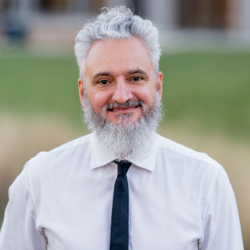
“We have been cooking this concept for three years with our longtime collaborators and kicked it off internally last spring,” said the unit’s Co-Director, Rodrigo Reis, professor and interim co-dean of the Brown School.
Reis said the work of PHP will directly connect with the equity, public health and climate goals of new strategic plans developed by both Washington University and the Brown School. It will also play a key role in the development of a new School of Public Health, an initiative the university announced last year.
The unit’s co-director is Deborah Salvo, formerly of the Brown School and now an associate professor at the University of Texas at Austin. Salvo led a recent project to study Forest Park in St. Louis and its impact on public health, one of the projects that is part of the unit’s research portfolio. “We’ve started to set things in place for the People, Health and Place Unit, and now we’re ready to show this to the world,” she said.
Salvo said the unit’s work will involve research, coursework and teaching at WashU, and local and global capacity building efforts. “The theme of what we do is health and place research,” she said. “We’re about team science and expanding the science and the message of how places matter in health.”
The PHP unit at the PRC/Brown School is leading the development of a global research group centered on the intersection of health and place work. As such, it is acting as the St. Louis based hub, and leading group, for an International People, Health and Place Research Group, which includes additional hubs/units in Austin, TX (led by Salvo), Mexico (led by Alejandra Jauregui – one of the panelists for the Public Health Speaker series event on Feb 8), and Brazil (led by Akira Hino – the other panelist for the Public Health Speaker series event on Feb 8). In terms of the International PHP Research Group, for which the WashU PHP unit is a leading actor, Reis said: “Right now, we’re primarily focusing on Latin America and Latino populations in the U.S., but we do plan to expand.”
“Our previous experiences working with global networks researching the impact of elements of the built environment, such as housing and transportation, on public health shows that this type of work is important to the U.S., where the struggles and challenges are quite similar to those we see in developing countries,” he added.
Current highlights of the ongoing work taking place at the WashU PHP unit include:
- Adapting, revising and hosting an updated version of the Built Environment Assessment Training (BEAT) Institute, a formal, online training program to be used in academic courses, in partnership with professor Karen Glanz, of the University of Pennsylvania, and original director of the BEAT Institute.
- Formalized partnerships with other researchers to create an international network, with whom Memorandums of Understanding have been executed. The network is now composed of colleagues in the U.S., Brazil, and Mexico. “When you look at health and place, changes like those in climate are most affecting developing countries,” Salvo said.
- Supporting the Global Observatory of Healthy and Sustainable Cities (GOHSC) and its 1000 Cities Challenge. The unit sponsored the development of the website for a new global surveillance system that tracks how well cities are being designed for, or have policies in place for health and sustainability. Salvo and Reis are both investigators of this initiative, in addition to being website sponsors. GOHSC currently has data for 25 cities in all inhabited continents of the world, and is seeking to expand its work to over 1000 global cities, through what they have denominated the 1000 Cities Challenge, which the PHP Unit supports.
The unit currently employs three students, including Ana Luiza Favarao Leao, a visiting Fulbright Scholar and doctoral student at the Urban Planning & Architecture Program at the State University of Londrina, Brazil. Her dissertation is about urban walkability and streetscapes, a good fit with the PHP’s work measuring qualities of the built environment for policy planning.
“It’s been a great, constructive experience,” she said of her work so far. “I’ve met so many experienced researchers in the built environment and public health, with a strong focus on global health, which I hadn’t experienced before.”
Áine O’Connor, who manages the unit with a focus on research, said she especially appreciates PHP’s niche, which focuses on the intersection of place and space and health, both globally and locally. “It’s a unique place for a public health unit to sit, and it has a focus on health equity,” she said. “One of the most exciting parts for me is the ability to see research that affects a lot of different places, with a global scale of impact. Our international, transdisciplinary partnerships mean we’re building capacity in a number of countries and our projects are going to be dedicated to the local community well-being. Our scope is very local and very global at the same time.”
O’Connor said the PHP’s long-term plan is to expand its development of capacity building and research efforts. “We plan to gain more partners and take this team science to different countries and continents, anywhere the built environment is of interest to researchers and practitioners,” she said.
She added that the unit’s far-flung leadership – she’s working from Dublin, Ireland, while the co-directors are in St. Louis and Texas – is appropriate for its mission. “I guess we’re attempting to practice what we preach!” she said.
Tonya Edmond, interim co-dean of the Brown School, has been inducted as a Fellow of the American Academy of Social Work and Social Welfare (AASWSW) for 2023. The AASWSW is an honorific society of distinguished scholars and practitioners who are dedicated to achieving excellence in the field of social work and social welfare.
Edmond is one of 14 scholars in the AASWSW Class of 2023 inductees. She joins more than a dozen current Brown School faculty members that have already achieved this honor and many more alumni. Fellows are recognized for their distinguished accomplishments as scholars and practitioners dedicated to achieving excellence in high-impact work that advances social good.
“I am truly humbled to have been inducted as a Fellow of the Academy for Social Work and Social Welfare. It is a tremendous honor to be recognized alongside scholars and practitioners that I have long admired,” Edmond said.
She was formally inducted as an AASWSW Fellow during the January 2023 Society for Social Work and Research’s Annual Conference in Phoenix, Arizona.
Edmond’s research focuses on testing the effectiveness of interventions for survivors of childhood sexual abuse, sexual assault, sex trafficking, and intimate partner violence. In January 2022, Edmond was appointed to serve as interim dean of the Brown School in partnership with Rodrigo Reis. Edmond is co-director of the Center for Violence and Injury Prevention and a faculty affiliate for the Center for Mental Health Services Research.
In addition to Edmond, current Brown School fellows include:
- Wendy Auslander, Barbara A. Bailey Professor of Social Work
- Leopoldo J. Cabassa, Professor and Director of PhD Program in Social Work
- Brett Drake, Professor of Data Science for the Social Good in Practice
- Michal Grinstein-Weiss, Shanti K. Khinduka Distinguished Professor
- Shenyang Guo, Frank J. Bruno Distinguished Professor of Social Work Research
- Sean Joe, Benjamin E. Youngdahl Professor of Social Development and Associate Dean for Faculty and Research
- Melissa Jonson-Reid, Ralph and Muriel Pumphrey Professor of Social Work Research
- Shanti Khinduka, George Warren Brown Distinguished University Professor Emeritus
- Mary McKay, Vice Provost of Interdisciplinary Initiatives, Dean of the Brown School (2016 – 2022)
- Nancy Morrow-Howell, Betty Bofinger Brown Distinguished Professor of Social Policy
- Enola Proctor, Professor, Shanti K. Khinduka Distinguished Professor (2014-2018)
- Mark Rank, Herbert S. Hadley Professor of Social Welfare
- Margaret Sherraden, Research Professor
- Michael Sherraden, George Warren Brown Distinguished University Professor
- Fred Ssewamala, William E. Gordon Distinguished Professor and Associate Dean for Transdisciplinary Faculty Research
Pamela L. Begay, PhD, LCSW, MSW ’04, has been appointed director of the Kathryn M. Buder Center for American Indian Studies at the Brown School. Begay, a member of the Navajo Nation of Shiprock, New Mexico, joined the Brown School in January 2022 as an Associate Professor of Practice and in April 2022, she took the helm of the Buder Center.
“For over 30 years, the Buder Center has been a beacon of light for the highest caliber of students and researchers interested in understanding and addressing the needs of Indigenous populations. Pamela Begay is no exception. She is a bold, dedicated, and compassionate clinician and researcher that will lift up the next generation of American Indian leaders. The Brown School is proud to name her director,” said Tonya Edmond, Interim Co-Dean of the Brown School.
Established in 1990, the Buder Center is a scholarship program committed to the education of American Indian students earning master’s degrees in social work. It has grown into one of the most respected centers in the nation for academic advancement and study of American Indian issues related to social work.
As director, Begay will continue to advance the important work of the Buder Center to teach and train the next generation of social work professionals who want to work in tribal and urban settings. As a practicing clinician, she has a particular focus on boosting the number of Buder Center and MSW graduates who pursue accreditation as licensed clinical social workers.
“There are not enough Native clinicians to fill all the job openings available in Indian Country,” Begay explained. “Numerous barriers exist to getting licensed. It’s a long, expensive process. In my teaching, I talk a lot about licensing. I want students to know that I am somebody they can come and talk to about that.”
According to the Council on Social Work Education, only 1% of all social work graduates are American Indians.
While a self-described “clinician at heart,” Begay always felt a pull toward academia. “The drive likely came from having been a student for so many years and having had so many amazing instructors and mentors.”
Begay grew up straddling two different worlds. She spent half her life in Long Beach, California, and half on her reservation in New Mexico.
The situation allowed her to move seamlessly between them, but while living in Long Beach, her Native side often felt invisible. “We mixed in with everybody else. However, no one knew that there were actually Native people still around,” Begay said. She credits that experience of invisibility with influencing her career as a helping professional, with a focus on serving Native people in a culturally appropriate way.
“I want to be a supporter. For example, I don’t think kids have to get in trouble to have a social worker talk to them or see them,” she said. “I want Native people to be seen, heard and taken seriously.”
Begay earned a doctorate in clinical social work from Smith College, a master’s in social work from the Brown School, where she was a Buder Scholar, and a bachelor’s degree in American Indian/Native American Studies from the University of New Mexico. In addition to directing the Buder Center, Begay also serves as chair of the American Indian/Alaska Native concentration and maintains a private telehealth clinical practice in New Mexico. She is the senior editor for the Journal of Indigenous Research and an editorial board member of the Clinical Social Work Journal.
IS-2 scholars and faculty participated in the first in-person Institute, hosted at the Charles Knight Center, Washington University in St. Louis (Tina McGrath Photography)
Scholars from across the U.S. gathered at the Brown School and on Zoom in November to participate in the first in-person training by the Institute for Implementation Science Scholars, IS-2 for short. The IS-2 program offers training in dissemination and implementation (D&I) science – methods and strategies to advance evidence-based ways to reduce the burden of chronic disease and address health inequities. Three cohorts of 59 early- and mid-career scholars have been participating in the mentored training. The sessions began in 2020, but were conducted virtually due to COVID-19. Some scholars participated virtually in the November session, but all who attended agreed the in-person setting provided extra benefits.
“Zoom meetings can work if you’re just trying to get a technical skill across to someone, but the in-person experience provides an ability to build relationships, enjoy a meal together, laugh together,” said Ross Brownson, the Steven H. and Susan U. Lipstein Distinguished Professor at the Brown School and director of the Prevention Research Center. “We’ve underestimated the importance of that human connection.” Brownson co-leads IS-2 with Debra Haire-Joshu, who holds the Joyce and Chauncy Buchheit Professorship in Public Health.
“I think this was really important to get people together,” said Haire-Joshu, who directs the Center for Diabetes Translation Research at Washington University. “Our scholars were so excited, so engaged. In-person, you put names and faces together in a different way and make connections that lead to more conversations, more idea generation, and more trust.”
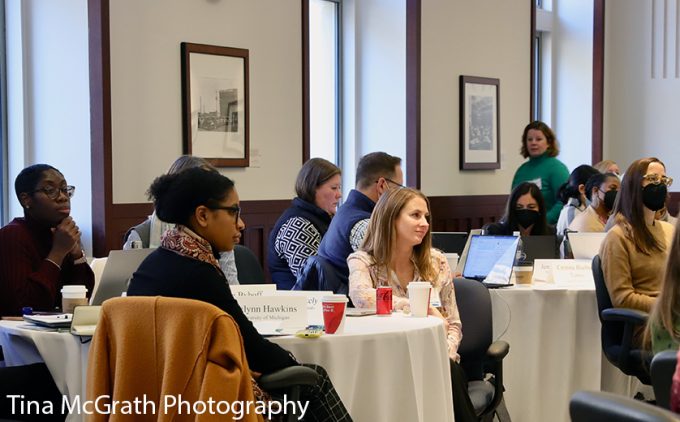
The program aims to train the next generation of researchers in the field of D&I science, whose goal is to shorten the gap between research discoveries and their use in community and clinical settings. The training sessions are a cornerstone of the program and involve a combination of group consultations and lectures focused on key D&I concepts, such as adapting interventions for different populations and developing interventions for dissemination and sustainability.
IS-2 works with key partners, including the National Institutes of Health and the Veterans Administration, to support the network of scholars and advance D&I training. The program includes 20 D&I experts, like Brownson and Haire-Joshu, as core faculty and mentors. For Haire-Joshu, mentoring is one of her favorite components of the IS-2 program.
“The mentees are all about getting their research up and going. For me, it’s a great way to make sure these really sharp people are able to advance their careers and advance science.”
Shelly Johnston, the coordinator of the training sessions, said the program’s contact with trainees doesn’t end when the training is over. “We try to keep them involved in the network,” she said. In addition to the sessions, scholars have the opportunity to participate in webinars, collaborative workgroups, and mock grant reviews to extend their learning and connections within the program. The last session will be held later this year and will include members of the cohorts from 2021 and 2022.
Participants in the November session were positive about their experiences and the benefits of the training regimen.
“A rich learning environment”
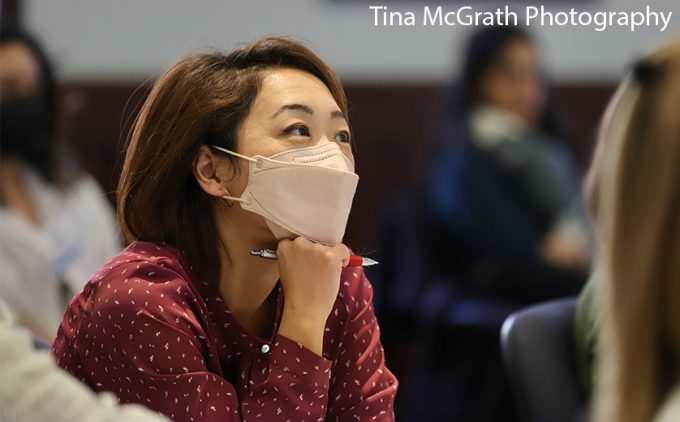
“I cannot say enough positive things about this high-quality training,” said Yuka Asada, clinical assistant professor of community health sciences at the University of Illinois-Chicago School of Public Health. “The combination of workshops, small group feedback sessions, and one-on-one mentoring is incredibly effective and makes it so helpful for an early-stage investigator like myself.” Asada, a registered dietitian, is working on a pilot study to improve access to federal nutrition support programs, like the Child and Adult Care Food Program. A 2021 scholar, she said her training mentor, Rachel Tabak, research associate professor at the Brown School, and other faculty, provided invaluable advice on developing grant proposals, focusing the scope of his project, as well as suggesting other experts with whom to consult. “Rachel is a human rolodex of references and always has several suggestions for relevant literature,” she said.
“It has been such a rich learning environment,” Asada said of the training, noting that peer-to-peer feedback and networking was also highly valuable. She said her experience in IS-2 also helped her develop and deliver the first doctoral-level course in implementation science in the DrPH program of the School of Public Health at UIC.
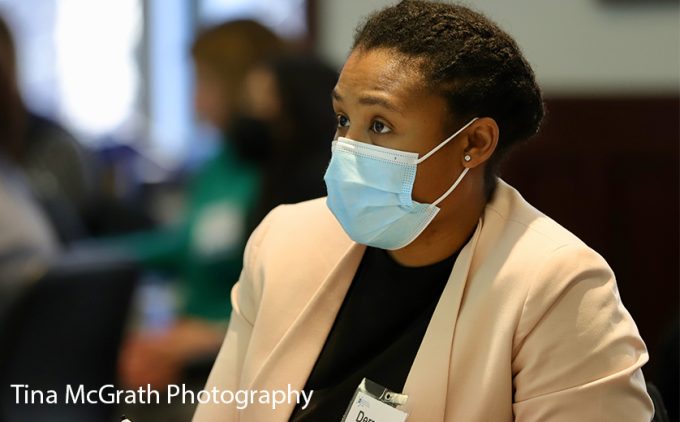
Derrecka Boykin, a 2022 scholar, is an assistant professor at the Menninger Department of Psychiatry and Behavioral Science in the Baylor College of Medicine. She is working on a project to develop a group therapy to meet the needs of women veterans who experience chronic pelvic pain – a difficult condition to treat due to the lack of gender-specific services in the VA. “I want to help people open up to how they can live their lives while living with pain,” she said. Boykin said the implementation science training helped her to consider ways to put the therapy she’s developing into practice through existing VA women’s health and pain programs, while considering patient perspectives, and adapting interventions for both urban and rural settings.
“I love this program,” she said, especially the advice from faculty experts and her mentor, Leopoldo Cabassa, a professor who directs the PhD program at the Brown School. “He’s a wealth of information and knowledge and like everyone is so approachable,” she said. “I’ve been trained to do clinical research, and I’ve come to implementation science really late. This training can help me get people what they need. You’ve got to find what works for you, and this has given me a plan for how I can apply all the things I’m learning to my own work.”
Using implementation science to enrich her research was also an aim of Allison Lewinski, a 2021 scholar who is an assistant research professor at the Duke University School of Nursing, and an investigator for the Durham Veterans Affairs Health Care System in Durham, NC. “Networking with mentors is great,” she said, noting in particular her mentor, Alison Hamilton, a professor at UCLA and Chief Officer of Implementation and Policy at the VA Center for the Study of Healthcare Innovation, Implementation & Policy at the Greater Los Angeles Healthcare System.
Lewinski said Hamilton’s expertise on veterans’ issues and implementation science was especially useful for Lewinski’s work researching ways to relieve distress in veterans with diabetes. “Just being able to bounce ideas off her has been a great experience,” she said. “I don’t want my intervention to just sit on a shelf. I want it to be useful to clinicians and veterans in the real world.”
She also found the interaction with other scholars to be valuable. “A critical aspect of why IS-2 has been an important piece in my journey as an early career researcher is because the program created a community who shared a similar interest in using D&I to improve health outcomes,” she said. “The IS-2 activities – the virtual and in-person institutes, work groups, and opportunities to connect–helped me foster substantive connections with my scientific community. I’ve been able to ‘nerd out’ with like-minded people.” The training also helped her focus on making sure interventions are equitable and to design projects from the ground up. “I’ve learned there are frameworks that can help guide grants from inception to completion,” she said. “You don’t just wing it, you have a map to guide you.”
Brownson noted that the IS-2 trainings will complement the Brown School’s new PhD in implementation science, which will be for both public health and social work students. He said the sessions showed the value of implementation science to post-doctoral researchers, as evidenced by the scholars’ appetite for the training. “The one thing I was really impressed with was the energy and the innovation of the scholars,” he said. “They’re already conducting research at a high level, and IS-2 can help take them to an even higher level.”
The importance of federal dietary guidelines and the effective use of improved nutrition data were among the aims of a recent National Academies of Science study about how the guidelines are developed, according to the Brown School’s Douglas Luke, who served on the panel. The committee released its report, Evaluating the Process to Develop the Dietary Guidelines for Americans, 2020-2025, in December.
The dietary guidelines and the evidence backing them up have advanced exponentially since the days of the U.S. Department of Agriculture’s food pyramid, said Luke, the Irving Louis Horowitz Professor in Social Policy and Director of the Center for Public Health Systems Science. “We have much better data and understanding of nutrition than the early days, including the recognition that nutrition needs change over the life course,” he said. He hopes the panel’s report, mandated by Congress, will bolster confidence in the guidelines and encourage the public to follow them. The last guidelines were issued in 2020, and the USDA is now at work on the next ones, which are being developed with the U.S. Department of Health and Human Services.
“The work of this committee reaffirmed the importance of the dietary guidelines but also the need to pay attention to the integrity of the development, the transparency of the process, and the need to take advantage of scientists in diet and nutrition who are working outside of the government,” he said. Luke was asked to join the panel to provide expertise on the use of systems science and systems thinking in developing the guidelines. Nutrition scientists do that in part by using data-based “food pattern modeling” to answer questions like “What would happen if added sugars were removed from a person’s diet?” Enhancing the use of food pattern modeling was one of seven recommendations made by the committee after 18 months of analyzing the development of the 2020-25 guidelines.
Luke said he appreciated the opportunity to champion systems science in such an important area of public health. He said systems thinking is critical for advancing nutrition science, as diet and nutrition are shaped by many complex systems, including the global food system, individual biology, the built environment, and national food and nutrition policies. “Diet and nutrition are hugely important for public health and connected to a lot of commercial interests,” he said. “A lot of people pay attention.”
One of those people happens to reside at Luke’s home, where he noticed ears perking up when he talked about his service on the committee. “It was one of the few times over the dinner table my wife was interested in what I do, and she immediately suggested that I should follow the same guidelines that I helped promote,” he joked.