Dorian Traube, a professor in the Suzanne Dworak-Peck School of Social Work at the University of Southern California, has been appointed as the next dean of the Brown School at Washington University in St. Louis, effective Aug. 1, announced Chancellor Andrew D. Martin.
Traube will succeed Tonya Edmond and Rodrigo Reis, professors and interim co-deans at the Brown School, who have served as interim deans since January 2022.
“I’m very excited that Dorian Traube will be the next dean of the Brown School,” Martin said. “The Brown School is a center of excellence for Washington University, and with an innovative leader like Dorian guiding the strategic vision, I’m confident we are well-positioned for even greater impact.”
“I want to thank Tonya Edmond and Rodrigo Reis for their outstanding service as interim co-deans. Their leadership of the Brown School over the past year has continued to advance the school’s mission of putting evidence-based research into practice.”
Traube has been on the USC faculty since 2006. Her research focuses on early child development, home visitation and telehealth solutions for families with young children.
Traube developed Parents as Teachers@Telebehavioral Health Clinic at USC, the first partnership of its kind between a national home visitation model and a university-based telehealth clinic. In doing so, she also established the first virtual home visitation program, offering a reliable home visitation model via video conferencing technology.
This program was chosen as a Named Commitment by the Clinton Global Initiative and was selected the winner of the Gary Community Investment/OpenIDEO Early Childhood Innovation Prize. In three years, the program offered more than 1,000 home visits and trained 25 home visitors in virtual service delivery strategies.
Traube’s research into the telehealth program laid the foundation for a $1.2 million effort, funded by the Heising-Simons Foundation, to make virtual home visitation available nationally during the COVID-19 crisis.
“The Brown School is renowned for its strengths in research, education, and practice,” said Beverly Wendland, provost and executive vice chancellor for academic affairs. “Dorian’s scholarship and demonstrated leadership position her well to lead one of the finest schools of social work in the country.”
“We have a tremendous history of achievement in social work, and, as we lay the foundation for a new era of public health at WashU, I look forward to partnering with Dorian and all our school deans in our shared pursuit of academic distinction.”
Traube’s research agenda focuses on the utilization of technological solutions to provide early childhood health, education and parent support services. She has expertise in children’s mental health, child maltreatment prevention, family support interventions and home visitation.
Her research has been funded by the National Institutes of Health (NIH), the Parsons Foundation, Queenscare Foundation, and the Overdeck Foundation. Traube is on the California Emerging Technology Fund board of directors.
“It’s an honor and a privilege to be named dean of the Brown School at Washington University,” Traube said. “The Brown School’s rich tradition of excellence in social work and public health, gifted students, innovative faculty, and the impact of their collaborative, problem-solving research and scholarship is evident locally, regionally and globally. I’m eager to partner with them, as together we strive to solve society’s greatest challenges.”
Traube earned master’s and doctoral degrees in social work from Columbia University and is a licensed clinical social worker in California and New York.
Katie Allen, MSW/MSP student, selected as finalist for PMF Program
Katie Allen, a dual degree Master of Social Work and Master of Social Policy student at the Brown School, has been named a finalist for the Presidential Management Fellows (PMF) Program, the federal government’s premier leadership development program for advanced degree holders.
Directed by the U.S. Office of Personnel Management, the PMF Program aims to develop the next generation of government leaders. Finalists are appointed to a two-year, full-time federal position with salary and benefits.
“I am ecstatic about this opportunity. It is an absolute honor to be selected as a finalist amongst a pool of incredibly smart, talented, and passionate individuals,” she said.
Allen is in the process of applying and interviewing for placement opportunities at various federal agencies. She’s interested in working on federal-level policy and decision-making, particularly in areas related to poverty, welfare, and economic opportunity for children and families.
“I am hoping to gain hands-on experience in designing, implementing, and/or evaluating federal programs and policies and engage in work that promotes equity and social justice on a national level.”
Allen said Amber Brown, manager of Career Services at the Brown School, played a key role in helping Allen discover and apply for the program.
“In chatting with Amber Brown about my general career interests and goals, she mentioned the PMF program to me,” Allen said. “She also connected me with a few Brown School alumni who had previously participated in the program. After talking to them about their experiences and the opportunities that have come their way, I knew I wanted to apply.”
Recent Brown School alum Madelyn Brandt, MSW ’22 was also named as a finalist for the PMF Program. In a post on her LinkedIn page, Brandt wrote: “Huge thanks to my mentors Brown School at Washington University in St. Louis for setting me up for success.”
Of the 10,000 individuals who applied for the program, 850 finalists were chosen for the class of 2023. The program has a high success rate, with on average, 87% of Fellows taking a permanent or term position following completion of the two-year program.
Poverty was closely associated with higher rates of dementia among older adults in Afghanistan in a newly published study by Jean-Francois Trani, associate professor at the Brown School. The results suggest that addressing education, health, employment and living conditions earlier in life can have an impact on dementia risk in later life, particularly in countries that are frequently in crisis, such as Afghanistan.
“It’s important to start now to understand the causes of dementia so we can change policy to benefit people who will age in the coming decades,” Trani said. “The problem of dementia is growing in low- and middle-income countries, and we can’t explain it just by genetic factors. This research is urgent and it has to be global.”
The study was part of a larger project looking at the social determinants of health associated with the risk of cognitive impairment and dementia in Afghanistan, Pakistan, and South Africa. The research team collected information among adults over 50 years old in two Afghan provinces between February and April 2022, examining multiple dimensions of deprivation.
They found that a higher proportion of adults with moderate-to-severe dementia were significantly more deprived of education, health, and employment and were more often distressed compared to adults without dementia. Only 21.8% adults without dementia were poor compared to 33.9% among those with mild dementia and 51.2% among those with moderate-to-severe dementia.
Important contributors to poverty were low education, poor healthcare access and unemployment, comparable to the team’s findings in South Africa. Poorer older adults in both countries were at higher risk of cognitive impairment and dementia, particularly those over 70 years old. “Our findings suggest that universal access to free quality education and healthcare during the life course might contribute to both prevention and lower dementia severity in later life, particularly in low-income countries in crisis such as Afghanistan, where difficulties are heightened,” Trani said.
Further research is needed, he added, to follow people over time to see if the poverty is a factor in causing dementia or simply associated with it.
The study, funded by a grant from the Alzheimer Association, was published in the April edition of Clinical Medicine.
Researchers at the Brown School used artificial intelligence (AI) to analyze hundreds of thousands of tweets to assess people’s attitudes toward soda taxes. Results were published recently in the Journal of Public Health Management and Practice.
The study was led by Ruopeng An, associate professor at the Brown School, who said the research demonstrated the value of AI technologies in analyzing large quantities of data. His team designed a comprehensive search algorithm to systematically identify soda-tax-related tweets.
“AI enables computer modeling that is useful in analyzing ‘big’ data that is massive in scale and messy to work with, such as images or unstructured texts like those in tweets,” he said.
An’s team identified and collected around 370,000 soda tax-related tweets posted between 2015-2022 and built AI models to classify those tweets by sentiments. They found that public attention paid to soda taxes peaked in 2016 and has since declined considerably. Soda taxes were proposed as a way to discourage soda consumption and combat obesity by taxing sugar-sweetened drinks.
The finalized neural network model achieved an accuracy of 88% in predicting tweet sentiments in the test set.
“Social media has the power to shape public opinion and catalyze social changes, but remains an underutilized source of information to inform government decision-making,” An added. “Modern social media sentiment analysis powered by AI technologies may inform the design, implementation, and modification of soda tax policies to gain social support while minimizing confusion and misinterpretation.”
Traditional polls and surveys are costly, offer little historical data or significant time delay. Social media sentiment analysis enables collecting and analyzing large volumes of social media data in near real-time, unrestrained by geographical boundaries, and at a fraction of the cost of those traditional methods.
An chairs the Artificial Intelligence Applications for Health Data Post-Masters Certificate and the Artificial Intelligence and Big Data Analytics for Public Health Certificate programs at WashU and teaches several graduate-level artificial intelligence and data science courses. The three coauthors of the study, Yuyi Yang, Quinlan Batcheller, and Qianzi Zhou, are Master of Public Health students at the Brown School.
As public health departments across the U.S. face increased scrutiny, the Brown School’s Prevention Research Center has partnered with the Brookings Institution in a groundbreaking investigation to identify ways to improve decision-making and more effectively use health department resources. The study’s latest findings, published in the American Journal of Preventive Medicine, used information from public health practice and computer modeling to test how various factors influence health department decisions about their programs.
At issue is “misimplementation” – the premature ending of effective activities or the continuation of ineffective programs, which waste resources and result in worse health outcomes.
“It is an extremely important study because up to one-third of public health programs are ended when they should continue or continue when they should have ended,” said Ross Brownson, the Steven H. and Susan U. Lipstein Distinguished Professor and the director of the PRC who was principal investigator for the study. “The agent-based model we created provides actionable ideas to address these issues, which could result in more effective and efficient public health practice.”
The lead author of the agent-based modeling methods and findings paper was Matt Kasman, assistant research director of the Center on Social Dynamics and Policy at the Brookings Institution, which created an animation to explain the model and what was learned. “Our research is the first application of a sophisticated, flexible, methodological approach to this important topic,” he said.
The creation of computer simulations was led by Ross Hammond, the Betty Bofinger Brown Distinguished Professor of Public Health at the Brown School. “I think this study is a great example of the potential a partnership between systems science and implementation science can have,” he said. “This is an important growth area for both fields.”
The simulations, based on information the team gathered from a national survey, interviews, and expert public health practitioners, showed that increasing either evidence-based decision-making or information sharing could reduce misimplementation. Shifting leadership priorities to emphasize effectiveness resulted in the largest reduction, while organizational restructuring had little impact. The key takeaway: Focusing decision-making on effectiveness and evaluation information, not how long a program has been in place, can greatly improve program continuation decision-making.
Kasman said the team’s findings are of immediate value. “Empirical evidence from the last decade shows significant room for improvement in effective allocation of resources through continuation decisions made by leadership in state public health departments,” he said. “Our findings point to some concrete, feasible actions that can be taken to do so. Now is an apt time to implement these changes to policy and practice, as state public health departments have recently faced increasing challenges both in terms of the magnitude of the problems that they confront as well as the politicization of their work. We hope that our work will help our public health system prepare for future crises that it will be called upon to confront.”
During the team’s interviews, health department managers and staff provided ways health departments can help ensure optimal decision-making based on evidence, and how leaders can help. An evaluation process in place when programs begin helped staff identify and document what wasn’t working and what needed to be adapted or discarded. Participants emphasized the importance of maintaining positive relationships with partners through close communication throughout the process.
Professor Rodrigo Reis (center) in discussions with public health scholars during a writing retreat held on WashU’s campus from January 31 – February 2, 2023.
Rodrigo Reis, professor of public health and interim co-dean of the Brown School recently led a three-day writing retreat for public health scholars as part of The Lancet series on physical activity and public health.
The group met at the Brown School for three days to design methods and develop the next steps on a research project to explore connections between physical activity, climate change adaptation, and mitigation through a planetary health lens. This initial meeting was sponsored and organized by the People, Health & Place Unit directed by Reis who is located with the Prevention Research Center.
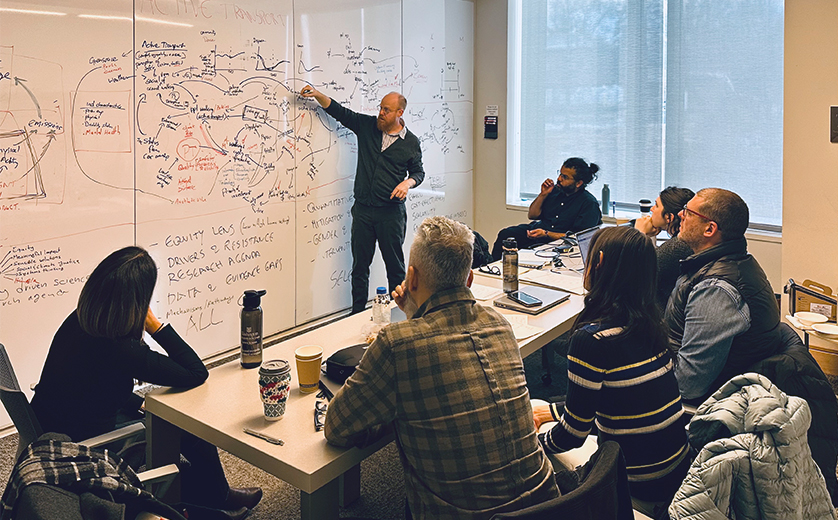
Participants from universities across the globe attended. They included Professor Erica Hinckson (Auckland University of Technology), Associate Professor Melody Ding (University of Sydney), Associate Professor Tarik Benmarhnia (University of California San Diego), Professor Pedro Hallal (University of Illinois at Champaign), Assistant Professor of Practice Ellis Ballard (Brown School), and also Ana Favarao (Fulbright Scholar from Brazil).
The team will be presenting the initial findings of the project in October 2023 in New Zealand during The Lancet scientific review meeting.