Similar to treatment resistant depression, there is a subpopulation of those addicted to opioids who do not respond to standard opioid use disorder (OUD) treatments. In a new paper, an addiction expert at the Brown School suggests a new category for these types of patients: treatment resistant opioid use disorder (TROUD).
“The field has suggested that if a treatment does not work, it is either the patient’s fault, they have not hit bottom, or simply we need to try the same treatment again,” said David Patterson Silver Wolf, associate professor and an expert on substance use disorder treatment. “This paper challenges the addiction research and treatment providers to change focus from individuals being resistant to the unique conditions associated with this brain disorder as being resistant to treatment as usual.”
Patterson Silver Wolf is co-author of “Treatment Resistant Opioid Use Disorder (TROUD): Definition, Rationale, and Recommendations,” recently published online in the Journal of the Neurological Sciences. His co-author is Mark Gold, adjunct professor in the Department of Psychiatry at Washington University School of Medicine in St. Louis.
Patterson Silver Wolf was reading about treatment resistant depression and thought some of the same mechanisms might apply to opioid addiction.
“I found out that it is unethical to recommend the same depression treatment that has already failed,” Patterson Silver Wolf said. “In substance use disorder treatment, this is exactly what we do, over and over again.”
“In this article, we discovered that patients being admitted to outpatient treatment and diagnosed with an opioid use disorder had upwards of 30 past treatment attempts. And the unfortunate fact was that they would most likely be receiving the same treatment as before. In substance use disorder treatment, the treatment does not change, we expect the individual to change.”
Patterson Silver Wolf defines TROUD in stages. “For example, Stage 1 TROUD would be failure of three standard OUD medications or behavioral treatments, either in combination or succession, with Stage 2 TROUD being five or more failures,” he said.
More research needs to be done on how widespread treatment resistance may be.
“We are analyzing data with a sample size of over 2 million admissions into substance use disorder treatment around the U.S.,” he said. “Of those 607,000 who were diagnosed with an opioid use disorder, about 120,000 reported five or more past treatment attempts. That represents about 20% who could be considered suffering from TROUD.”
Can TROUD be treated?
“This is the million-dollar question,” Patterson Silver Wolf said. “Unfortunately, our substance use disorder treatment industry offers very limited options for those who might be diagnosed as suffering with TROUD. It consists of about three medications, two of which are themselves opioids, and treatment as usual.
“Following the work of treatment resistant depression and the renaissance of testing psychedelic drugs as treatment options, we in the substance use disorder treatment and research fields have to be open to trying new, or in psychedelic literature, older ways of helping this suffering population.
“There is a robust historical literature showing the efficacy of psychedelic drugs as addiction treatment. Regardless, if we join the renaissance or not, we must expand the treatment options for those suffering from TROUD,” Patterson Silver Wolf said.
The opioid overdose epidemic kills about 130 people a day in the United States and it is estimated that there are about 2.1 million people who suffer from an opioid use disorder.
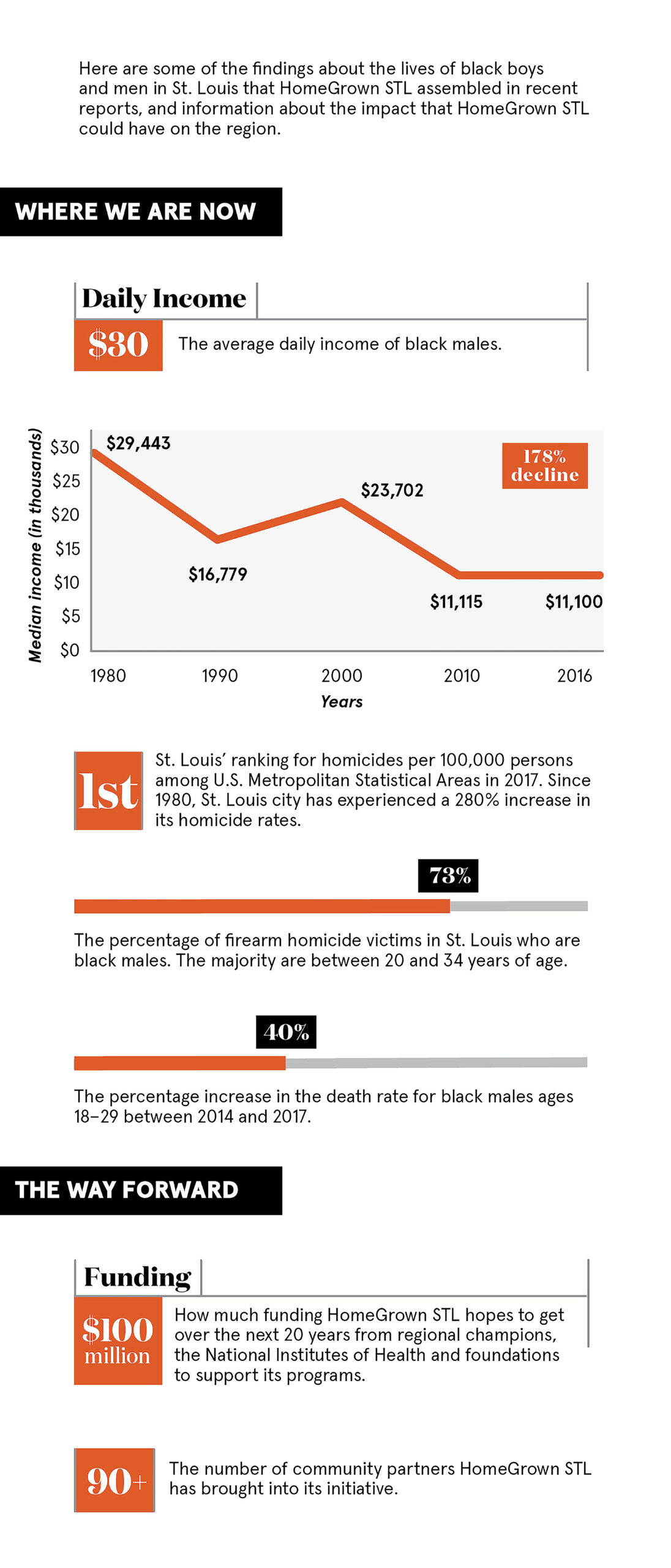
On Aug. 9, 2014, Michael Brown, an unarmed black teenager, was shot and killed by a white police officer in Ferguson, Missouri. The next day, Sean Joe, the Benjamin E. Youngdahl Professor of Social Development, arrived in St. Louis. When he’d been considering the move to St. Louis, he’d thought the city was ripe for a population-wide initiative for black males. Now he saw that the need for intervention was urgent.
“The experience of young black males was represented by the experience of Michael Brown and others who have followed over the years,” says Joe, also associate dean for faculty and research at the Brown School. In the United States, for black males ages 18-29, homicide is a leading cause of death whether by the police or a peer.
“Black boys are vulnerable,” Joe says. “They’re seen as different. They’re seen as bigger, bigger than they actually are physically, just like Michael Brown. There’s not enough empathy for young black males.”
Joe hopes to change that with HomeGrown STL, an initiative he started working on almost as soon as he arrived in St. Louis. Housed in the Race and Opportunity Lab in the Center for Social Development at the Brown School, HomeGrown STL hopes to improve the social mobility of the region’s 60,000 black boys and young men, ages 12-29, in one generation—by the year 2039. Social mobility is defined as the ability of black boys and men to move upward and attain a better life than their parents.
Changing the lives of 60,000 people is a huge community science undertaking. These last few years have been spent in securing funding, doing research on the current social mobility of the lives of black boys and men in the St. Louis metro area, designing key strategies, and organizing key stakeholders around the initiative.
So far, HomeGrown STL has been awarded $2.5 million from the National Institutes of Health and has been named a “Community to Watch” by the Obama Foundation’s My Brother’s Keeper Alliance (MBK). Former President Barack Obama launched MBK to “address the persistent opportunity gaps faced by boys and young men of color.” The alliance will provide support and technical assistance to strengthen funding proposals.
In February 2019, HomeGrown STL started a Catchment Area Pilot, with the goal of improving the lives of 8,000 black boys and young men ages 12-19 and developing a strategy to scale up for the region.
“We’ll see the benefits in a variety of systems when black males are prospering and doing well,” Joe says. “It will change not only the black male experience, but St. Louis’ economic power as well.”
Grandparental child care is linked to nearly a 30% increase in childhood overweight and obesity risk, finds a new analysis from the Brown School at Washington University in St. Louis.
In a study, published online Jan. 22 in Childhood Obesity, researchers discovered that grandparents could impact their grandchildren’s waistline in various ways, such as influencing their daily diet and physical activity, as well shaping their grandchildren’s perceptions on what represents a healthy lifestyle.
“The past decades have witnessed a rapid increase in life expectancy. Older adults are not only living longer but also being healthier and more productive than ever before,” said Ruopeng An, assistant professor at the Brown School and lead author. “For many, grandparenting is the highlight of their later years, and we observe grandparental care to be more common over time in the U.S. and other parts of the world.”
When the Pew Research Center surveyed older people regarding their most valuable experience during aging, 19% of the men and 31% of the women referred to spending time with their grandchildren, An said. Some grandparents offer intensive care for their grandchildren while others offer intermittent assistance. In total, nearly 40% offer some grandchild care, and nearly a third assist with errands, housework or home repairs in the U.S., he said.
“Grandparents’ influence on their grandchildren’s growth and development can be profound,” An said. “Through offering wisdom, teaching traditions, providing guidance and making memories, grandparents are often able to leave behind a legacy that their grandchildren will cherish and benefit lifelong. However, some negative influences from grandparental care may also be present and cannot be overlooked.”
An and his co-authors — from the University of Michigan, Shanghai University and Overseas Chinese College in Beijing — conducted a comprehensive review and data analysis on the scientific literature that studied the relationship between grandparental care and childhood obesity.
In An’s paper, “Influence of Grandparental Child Care on Childhood Obesity: A Systematic Review and Meta-Analysis, he and his co-authors reviewed a total of 23 studies. Eight studies were conducted in China, five in Japan, three in the United Kingdom, two in the U.S. and one each in five other countries. Twelve studies focused on grandparents’ roles as a main caregiver in the family and seven on grandparents’ co-residence.
“Affluence and being well fed is valued and desirable to many grandparents as they had experienced hunger and poverty in their youth, which they may pass on to their grandchildren, who, to the opposite, are fighting against a world of food swamps and ever-expanding portion size,” An said.
“The notion of ‘the bigger the healthier’ is still relevant,” he said. “Some grandparents may perceive heavier body weight in children as a sign of being healthy. As such, some children are urged to eat larger and more frequent meals. Some grandparents may provide children with sweets and fried food as a way to show love and kindness. In fact, in some cultures, grandparents may also be more likely to excuse children from doing household chores, a key form of physical activity.”
To his surprise, An said, the positive association between grandparental childcare and childhood overweight and obesity was not found to differ between countries.
“Grandparental care is long known to have deep cultural roots,” he said. “Based on Ziarat Hossain’s research, grandparents in western countries provide care when they are needed and called upon, known as the ‘non-interference’ approach.
“On the other hand, grandparents in Asian and African countries are so active and direct in their grandchild’s lives that they sometimes are considered the ‘two additional sets of parents.’ What underlines the lack of difference in the influence of grandparental care on childhood obesity? No concrete conclusions can be drawn at this moment and future research is needed.”
Although meta-analysis identified a positive association between grandparental child care and childhood overweight and obesity, grandparental child care was not associated with children’s Body Mass Index (BMI) z-scores — the accepted measure for childhood weight adjusted for age and sex. (A z-score gives an idea of how far from the mean a data point is.)
“This is likely due to lack of statistical power given that only four studies included in this review analyzed children’s BMI z-scores. It is also possible that the relationship between grandparental child care and childhood obesity is more complicated than a simple linear relationship,” An said.
“The impact of grandparenting is multilayered and complex,” he said. “Through research, we hope to provide scientific support for both grandparents and their grandchildren to make the best out of their precious, bonding relationship.”
Margaret Sherraden was among 19 fellows inducted into the American Academy of Social Work and Social Welfare during a ceremony held in Washington, D.C., on January 17, 2020.
“I was very excited by Margaret’s nomination and election, because I have been impressed by her work for years.” said Sarah Gehlert, president of the academy and dean of the College of Social Work at the University of South Carolina.
A pioneer in research on financial capability, Sherraden is author of six books, including the coauthored 2018 “Financial Capability and Asset Building in Vulnerable Households,” and numerous journal articles. Much of her work centers on equipping social workers to guide clients through financial and economic challenges in their everyday lives and on preparing human service professionals for the job of broadening access to inclusive financial policies and services.
“I am deeply honored and pleased that the academy has recognized the team’s work bringing financial capability back into the social work discipline,” said Sherraden. A faculty director with the Center for Social Development and research professor in the Brown School at Washington University, Sherraden also is professor emerita in the School of Social Work at the University of Missouri–St. Louis.
Sherraden joins a society of over 150 fellows. Founded in 2009, the academy promotes outstanding research and practice in social work and social welfare. New members are nominated by the academy’s enrolled fellows and inducted in an annual ceremony held in conjunction with other professional meetings.
In 2012, the academy launched the Grand Challenges for Social Work initiative, which has formed networks of scholars and practitioners dedicated to addressing 12 pressing national challenges.
Sherraden is one of the leaders of the Grand Challenge to “build financial capability and assets for all” and, with colleagues at CSD and elsewhere, a creator of financial social work curricula for human service professionals in the United States, Singapore, and China. A former Fulbright Fellow and president of the Missouri Association for Social Welfare, Sherraden also has published research on microenterprise, immigrant birth outcomes, international service, and social work’s historical role in voter engagement.
Speaking in April 2017, Sherraden framed her work: “Families are strapped and worried that they’re falling behind—like they and their children will not do as well as well as their parents. They need guidance, information, and opportunities to build financial stability and security. And they often turn to social workers. Social workers have an important and unique way to contribute to the well-being of these families and communities.”
An intervention integrating child savings accounts with financial literacy and income-generating activities for families with children who have lost parents to HIV/AIDS in Uganda resulted in health and emotional benefits for the children, according to a new study from the Brown School at Washington University in St. Louis.
The study is a cost-effectiveness analysis of Bridges to the Future, a randomized control trial that incorporates child savings accounts with financial literacy training and microfinance/income-generating activities for 1,410 schoolchildren orphaned by AIDS. One arm of the intervention provided a 1-1 match incentive for savings accounts, while another arm provided a 2-1 match.
After four years, the study showed that the larger match significantly improved self-rated health, HIV knowledge, self-concept and self-efficacy and lowered hopelessness in children. The smaller match accounts improved only self-rated health.
“Children who have lost a parent to HIV/AIDS face multiple stressors affecting their health and development,” wrote the study’s senior author, Fred Ssewamala, William E. Gordon Distinguished Professor at the Brown School. “Family economic empowerment interventions have the potential to improve these outcomes and mitigate the risks they face. These findings contribute to the evidence supporting the incorporation of economic empowerment interventions within national social protection frameworks.”
The study was published Dec. 31 in PLOS ONE. Read more here.
As the Kathryn M. Buder Center for American Indian Studies celebrates three decades at the Brown School, it has emerged as the preeminent center for the academic advancement and study of American Indian issues related to social work, public health and public policy.
Offering a unique graduate degree focus for social work students, the center recruits American Indian scholars and provides student support in a rigorous course of study; develops curriculum; conducts research, and engages in policy development that has a positive influence on Native populations.
Kathryn M. Buder respected and admired American Indians since childhood and believed that education was a key factor in maintaining self-esteem and growth in tribal communities. In 1990, she established the G.A., Jr. and Kathryn M. Buder Charitable Foundation to provide scholarships for American Indian students through the center, as well as funding for staff and student development. The foundation funds two-year scholarships covering the tuition, living expenses, books and professional development of up to 10 first- and second-year MSW students on a continuing basis.
Center Director Kellie Thompson (Seneca) sees the center’s 30th anniversary as an opportunity to honor the founding vision of Kathryn Buder while also looking to a future that is evolving as the needs of students and communities change. The issues facing Native individuals and communities—continued vulnerability to mental health issues, suicide, generational trauma and substance abuse—require multi-faceted solutions rooted in the resiliency and strength of these communities.
“We still have the same vision as when the center was founded in 1990: Preparing Native students to become leaders in Native communities,” Thompson said. “But after 30 years, the Buder Center has more than 200 alumni representing 77 tribes in the U.S, and they are working in a variety of settings and fields. The reach and network we have is much greater, and deeper in its expertise.”
One of the members of that network is Joe Masters, MSW ’13 (Sault St. Marie Band of Chippewa), now a behavior health therapist at SSM Health in St. Louis. He said his experience at Brown after becoming a first-generation college graduate near his tribal home in northern Michigan gave him the confidence to undertake a life-changing challenge.
“It’s not easy to come off the reservation and into a city like St. Louis,” said Masters. “The support of the Buder family of other Native students and the Buder Center was a key to my success.”
Masters wanted to pursue a career in mental health and management, but wanted training in a program that included a Native American perspective. “Being a Native, we always look at things through two different lenses,” he said. “The Buder Center offers that second lens.”
That perspective will strengthen his work when he returns to his community, but it has also added a holistic approach to therapy that he believes has bolstered his current work in St. Louis. Telling stories, a key feature of Indian culture, is also an effective therapeutic element for his clients. “They see themselves in the story,” he said.
Like many alumni, Masters stays in touch with the center and returns to visit for events such as the annual Washington University Pow Wow, where both Native and non-Native people come together for conversation, craft vendors and the centerpiece dance contests. Alumni also return to speak, mentor students and serve as practicum supervisors.
Sarah Kastelic (Alutiiq), MSW ’97, PhD ’08, who is the Executive Director of the National Indian Child Welfare Association and the recipient of a Distinguished Alumni Award from the Brown School, has welcomed the opportunity to partner in research activities and to host and supervise Buder scholars in their practica. She is pleased to give back to the center.
“As a first-generation college student, the Buder scholarship made graduate education possible for me. The Native-specific content prepared me for a career in public policy and Native human services and changed the trajectory of my career.”
Before joining NICWA, Kastelic led the National Congress of American Indians’ welfare reform program, where she saw the need for timely, credible data to inform policymaking at the tribal and national levels, a gap that her Buder training helped her fill. Policy is still a focus for her at NICWA, a national child advocacy organization.
The Buder Center had a similar impact on Caitlin Donald (Osage, Ponca), MSW ’14, the Program Manager for the Northwest Native American Center of Excellence at Oregon Health & Science University in Portland, Oregon. “The Buder Center transformed my graduate school experience, providing me with a robust and lifelong learning community of American Indian and Alaska Native capacity builders, change makers, and healers,” she said. “Years later, I still feel and am grateful for its impact on my life.” And the impact it has had on the people she serves is also profound.
The center’s director of research is David Patterson Silver Wolf, associate professor, who also chairs the American Indian and Alaska Native concentration. He said training students from native communities provides better social work and public health services to those communities.
“Buder Scholars are obtaining a graduate degree so they can better help their own people. When social workers have personal connections to communities they plan to serve, practices and decisions are rooted in how they will impact on us, rather than on them,” he explained.
He also points out that having Buder scholars in other classes brings context and awareness the Brown School would not have otherwise.
The changing needs of Native communities have prompted a fine-tuning of the concentration, for example the addition of an Indigenous Mental Health Practice course, Patterson Silver Wolf said. “We’re also branching out from student services to increase our research capacity, partnering with nations and tribes to figure out what works for particular communities.”
Noting that 70% of Native Americans live in urban areas, he said the center is aiming to develop a science around the needs of urban Natives, as well as graduates who serve their Native communities off reservations.
Although Joe Masters has spent his years since graduation in St. Louis, he plans to return someday to his Michigan roots to practice his skills as a therapist. In the meantime, he said, he’ll stay connected with the Buder Center, which he looks forward to visiting regularly.
“It feels like going back home again,” he said.
“The Center’s founding goals have helped to inspire and fulfill the Brown School’s mission to achieve equity and social justice for vulnerable populations,” said Mary McKay, Neidorff Family and Centene Corporation Dean at the Brown School. “We are so proud to have this one-of-a kind Center and its alumni working for the benefit of Native communities across the United States.”